

Owl Posting turned two this month. It’s difficult to ascribe any emotion to this whole endeavor other than love. You would think it’d get old at this point, but it hasn’t. Every single article still feels like I am twelve years old, staring up at a great big endless blue sky, and thinking that it’s going to swallow me up any second. Like a child, I believe in those moments that nobody has ever felt what I feel. Each time I hit ‘publish’ feels like love too, but the horrible kind, like I am watching someone die, their organs falling out of their chest as their eyes twinkle, telling me that they really enjoyed spending this time with me. I turn away, weeping, as their light fades. And then another creature walks through the door, with such an interesting energy to them, and I fall in love all over again, and the whole cycle repeats.
This all seems quite melodramatic. Perhaps some things are that serious, but certainly not running a blog. But unfortunately, you don’t get much say in what you end up loving. You can spend your whole life avoiding the subject, darting your eyes towards it as the days, months, years go by, never breaking down, never shamefully admitting what you actually desire most. Some people spend their whole lives in this pattern. Can you imagine? Of course you can! Because it is not just ‘some’ people, it is all of us. Nobody is free from the tragedy of self-denial. In exchange for this cruelty, life does sometimes throw us a bone: a chance to embrace the things that you love in a manner that is entirely inconsequential, utterly cost-free in every respect other than having the self-awareness necessary to reach out and grab it.
I have experienced this once, and it is writing.
This year, I wrote 24 essays, totaling ~108,000 words. I also filmed 8 podcasts, which I’ll discuss near the end.
Some of the written work, I admit, was not very good. For example, ‘Drugs currently in clinical trials will likely not be impacted by AI’ suffers from the sin of being boring in the worst possible way—obvious in the non-surprising parts, and likely wrong in the surprising parts. I suspect this is due to the fact that I wrote that article while unemployed, and thus exuberantly happy. Happiness is not strictly bad for writing, but it does not help things. What is strictly necessary for writing is pressure, an angry cloud hovering above your head wiggling its damp finger in your ear. Having a job with its own demands is a good way to create pressure, and barring that, it is up to you and you alone to supply that.

Luckily, I internalized this after a few weeks of unemployment, and shortly thereafter produced what remains, to this day, the most popular article I have ever written: ‘Endometriosis is an incredibly interesting disease’.

The endometriosis piece is interesting, because I did not at all expect it to go anywhere. In fact, I distinctly remember conferring with Claude—Opus 3 if I remember correctly—the night before its publication as to whether the title of the essay would be considered offensive. Yes, the model screamed, it is offensive, nobody wants their disease to be viewed as ‘interesting’. It begged me to change it, that I’d be hung from the rafters otherwise. In fact, the model mused, I may even kill you myself. In a decision that surprised even me, I stuck to my guns. And the essay ended up being a breakout success in a very classic sense, which is not something I ever expected to happen for the type of writing I do. It also indirectly led to the person who inspired the article in the first place to be recruited to work on endometriosis research at a great startup, which is probably the most positive side effect of anything I have ever done via writing.
Moving on: I only did two ‘Startup’ posts this year, which is 50% lower than I did in the previous year. The first was over EvE Bio (a non-profit) and the other was over Leash Bio—both of whom are wonderful. I’d really like to do more of these, but this type of writing is hard. You are basically acting like a comms employee, but with zero internal visibility into anything at all, which means you have to make a bunch of predictions that are almost certainly wildly incorrect. So why did I do these at all? EvE is just one of those ‘it’s boring, but so useful for humanity’ missions that felt irresponsible not to cover. And Leash has interesting science, yes, but the culture itself felt even more interesting, and how often do you find bio-ML companies with a culture worth talking about?


What is especially fun about these two is that they seem quite boring to a general audience—unlike the endometriosis one, which I consider genuinely interesting to laymen—and yet both were decently popular across social media. This is strange, and permanently updated my understanding of what could be considered ‘popular science’. I don’t think I talked down to anyone at all—the EvE essay has phrases like ‘Tango β-arrestin recruitment assays for 7TMs/GPCRs’—and yet non-biologists seemingly enjoyed it.
What else? Well, I joined a great bio-ML startup, Noetik, the reasons for which I detail here, and for the first time, I was constantly around a breed of individual I had never interacted with before: cancer biologists. I consider cancer experts a minor deity in the cosmic pantheon, all of whom are capable of providing an essentially infinite amount of information about one of the most complex diseases that afflict humanity. As a result, I am a big fan of them. And as I gobbled up information from these folks, I slowly became comfortable with the idea of putting together an essay over cancer.
Cancer is difficult to write about. There is a universe of popular essays and books that already exist on the subject, and I imagined a potential reader would roll their eyes if they observed that I am relying on some cliche. After many weeks of deep thought, I came across what I felt was a relatively unique angle: there will never be another Keytruda. At least, not in the sense of ‘a cancer drug that works extremely well across many cancer subtypes’—we have almost certainly discovered them all. What there will be are many cancer drugs that work for very specific patient populations. Thus, the job of the oncology field should be to discover these very specific patient populations, and what drug works best for specifically them. This led to ‘Cancer has a surprising amount of detail’.

It’s a very clean essay, and I am lucky to have it be part of the Works in Progress Issue 23 book (you should pick one up!). Not too many afterthoughts on it other than that it is one of the only pieces of mine where it required long stretches of deep thought to figure out the tempo. Writing is not always like research, but when it is, it is really like research.
Most of the other things I published this year were brought about via being nerd-sniped by a third party. The big upside of running a technical blog is that random folks will come up to you and patiently explain the insane intricacies of their field, and at that point, they’ve already kind of handed you the essay. It feels a bit lazy to not staple together the interesting things they told you—along with interviews with others to flesh the piece out—and put it out there. Four essays this year could be attributed to a particular person, whose passion for the subject was so infectious that it grabbed me too.
The first was, ‘RNA structure prediction is hard. How much does that matter?’ which was prompted by Connor Stephens, who told me about the difficulty of RNA modeling at an event I co-ran while visiting SF. The second was ‘Questions to ask when evaluating neurotech approaches’, which was prompted by Milan Cvitkovic, whom I met multiple times throughout 2024 and 2025, growing increasingly shocked at how much all-encompassing knowledge he had over the neurotech field. The third was ‘Heuristics for lab robotics, and where its future may go’, which was prompted by Michelle Lee, after visiting the company she founded and seeing, for the first time in my life, robotic arms performing wet-lab tasks. And finally, the fourth was ‘Reasons to be pessimistic (and optimistic) on the future of biosecurity’, which could be partially attributed to multiple people, but whose core orchestrator was Jacob Trefethen.


If I were forced to pick favorites amongst this year’s essays, I would point at these four, all of which required an order of magnitude more ‘worldview-expanding’ than any of the pieces I published during the first year of writing.
They were painful to stitch together. The RNA one required an immense amount of editing to deal with the fact that I was just completely incorrect in my first draft, the neurotech one languished in my drafts for months because I couldn’t figure out how to divide the sections, and both the lab robotics and biosecurity ones required so many interviews with domain experts (~12 and ~16 respectively!) before I felt confident enough in my perspective to put something out there. Maybe in an ideal world, I would only write pieces like these, since they are both very fun to create and probably the most counterfactually valuable thing I could produce, as most everyone else who could create something similar has better things to do. Unfortunately, making these requires an insane amount of time, is especially stressful, and is mostly impossible to consistently do without writing full-time. But fun to do in sprints!
However, favorites exist in many dimensions. While the aforementioned four were my favorite in the ‘jeez, I can’t believe I managed to do that” axis, there is one more that I’m a big fan of: the ‘saying something I’ve wanted to say for years’ axis. And the essay that scored best there was ‘Ask not why would you work in biology, but rather: why wouldn’t you?'.

This is, I think, the only thing I’ve ever published that is blatant emotional manipulation. I get why so many writers make that their whole shtick. It really is genuinely fun to cradle your reader’s head between your palms, and force them to stare at your worst fears and anxieties, trying to ignite those same fears and anxieties within their hearts. You feel powerful. You feel in control. I also get why so many of the same writers who constantly do this have deeply antisocial tendencies. There is something a little horrible, even soulless, about creating stuff like this. Some people may be able to do it forever, but I could not.
This all said: I believe every word I wrote in it. It echoes core beliefs I’ve had since I was twenty-three, and at no point in the piece do I veer off into territory that I don’t ponder at least once a week. I think about painful medical procedures often. I think about dementia often. I think about the fragility of my flesh often. When I was twenty-three, I was very upset at all this, and hated those around me who did not see what I saw: the writing on the wall for what awaits them, me, everyone. Our brains will turn to soup, our eyes will whiten, our fingers will tremble until they can barely hold a spoon. It felt so obvious to me that all wars, all petty conflicts, all of this useless bickering should be ceased until we figure out the solution here! The entirety of not only the US’s treasury, but every nation’s treasury, should be funneled into this effort. What else could possibly matter?
At twenty-eight, I still believe all this, but I have less anger about it all after funneling those anxieties into my own writing and work. Clean your own room first, you know? Still, it was a relief to get all this out of my skull and onto words on a page, and it is the only article of mine that I re-read every now and then.
This year has also involved some experimentation outside of purely technical writing. ‘A vibe check on the San Francisco biotech scene’ discusses the seeming disappearance of optimism amongst life-sciences founders and employees in the Bay Area; a location I have grown increasingly enamoured with. ‘Human art in a post-AI world should be strange’ is more for myself than for others, and was brought about by seeing how good the modern LLMs are at writing. Will this blog disappear soon after Opus 4.7? Maybe! It does increasingly feel as if the last remaining bit of alpha I have as a writer is being able to organize a piece rather than actually being able to write it. Luckily for me, all the LLMs seem to be quite bad at that. Unluckily for me, the LLMs seem to keep getting better at the things they are bad at.


On a similar note, this year had more fiction. ‘A compilation of eleven stories’ is exactly what it sounds like. There’s also an unemployment-era piece, ‘A body most amenable to experimentation’ and, no surprises, it was not very good and I kind of regret releasing it. The core theme is interesting (what if all in-vivo experimentation were done on a single creature?), but I think I really bungled the execution. Happily, I learned a few lessons and went on to have two fiction pieces in 2026 that I really liked: ‘The origin of rot’ and ‘The truth behind the 2026 J.P. Morgan Healthcare Conference’, both of which are long-form investigative journalism articles into something entirely fake. In fact, the J.P. Morgan one is the second-most-read thing I’ve published. I’d like to do more of these in the future—I have a lot of fiction in the drafts—but these pieces require a fair bit more courage than the technical pieces to send out, and so I end up spending a lot more time editing them than my usual articles.


That covers the writing. How about podcasts?
As mentioned, I filmed 8 this year, which is four times more than the prior year! And with view-counts that are somewhat respectable given that the TAM for this sort of content is almost certainly quite small.
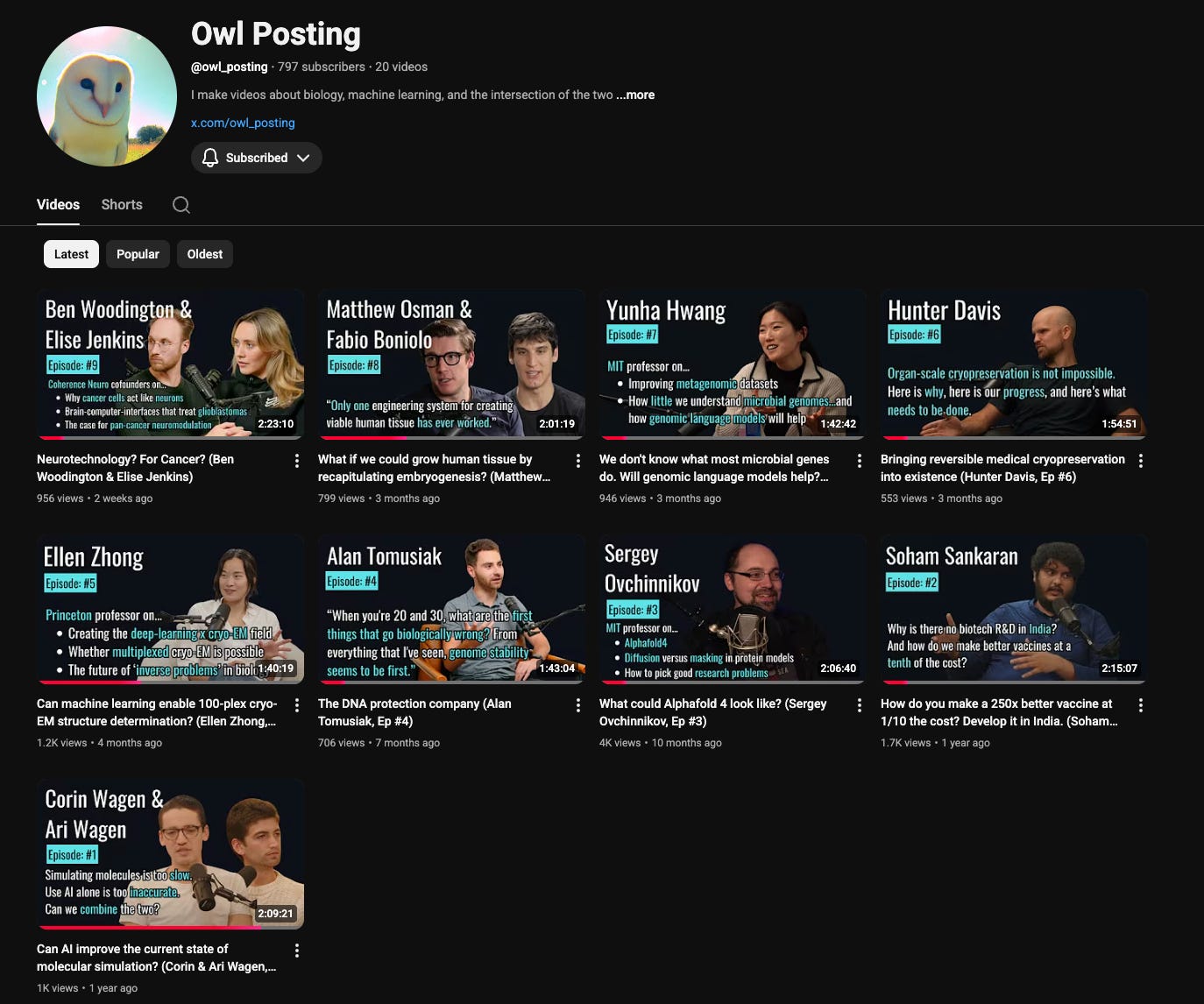
Overall, the episodes were wonderful. I achieved my life dream of having Sergey Ovchinnikov and Ellen Zhong on, both of whose episodes were unsurprisingly the most-watched of this year. I kind of wanted to stop after that, but I kept stumbling across people with such interesting research directions that I kept going. I really enjoyed all of them, but given that Hunter’s episode is the least-watched despite being incredibly cool (did you know that organ transplant companies have a suite of private jets to ferry organs around?), I’m going to plug specifically his here and recommend you watch it:
This all said: I’m still unsure whether to keep doing these. On one hand, they are fun to make and are genuinely informative for the few people who watch them. In the case of interviewing founders, the podcasts also seem to be reasonably useful for making both potential employees and investors aware that they exist. On the other hand, they are a huge pain to edit, and my attempts to outsource have not really resulted in a smaller workload. It also costs a fair bit to rent a studio for these, and consistent sponsors have not yet emerged. As it stands, the podcast is in this weird middle-ground where they clearly have some audience of people worth advertising to, but most potential sponsors (e.g. CRO’s) either aren’t used to sponsoring podcasts and, if they are, would rather spend the money on, say, Luke Timmerman’s much larger audience base. To be clear: this is completely fair, I would do the same if I were in their position.
I’ve managed to stay in the black thanks to individual philanthropic gestures, which I’m deeply grateful for, but I’d ideally prefer not eating into people’s wallets without giving them something in return. I have ~2 more planned, but I may take a hiatus after that. Not the biggest loss in the world; my writing is niche, and podcast viewers are a sub-niche of that niche.
And that’s that for year two.
To end this off: while putting this together, I re-read my first anniversary post. It’s surprising how much things stay the same, but it is also surprising how much more I enjoy my writing now compared to articles from the first year. Some people really, really hate my style and I realize it isn’t for everyone, but I personally like it. I think I’m inching closer to whatever my own internal monologue is. And perhaps—though I’m unsure whether I actually believe this—having a polarizing writing style is all one can hope for, as the only alternative is a writing style that nobody reads at all.
What’s next? I have a few topics in the pipeline, but I’m taking a week off; the last few articles took up a lot of brainpower. But there’s a lot going on in the world right now that’s worth discussing: the bottlenecks to better cancer vaccines, protein models that can generate binders to intrinsically-disordered-proteins, in-vivo CAR-T getting closer to market, the differing strategies of liquid biopsy companies, strange therapeutic modalities, and a lot more. One thing that has changed in the last year is that I no longer feel worried about running out of topics. There’s just so, so much to cover.
Happy 2nd birthday! Your best writing is genuinely some of the best I have seen on Substack, and has really inspired me to commit to writing about stuff that I care about (and not necessarily what I might suspect a potential reader would care about). There's a unique sense of authenticity that I can sniff off your writing that is only possible when genuine passion (and to some degree obsession) exists for the topic of interest. I love biology and deep learning as well, and am glad to see someone else dedicate so much cognitive effort to formalizing many of the things I turn over in my brain constantly.
Happy birthday! You have a great blog. I've really enjoyed your forays into fiction as well. To many more years!