
The truth behind the 2026 J.P. Morgan Healthcare Conference
2.8k words, 13 minutes reading time


Note: I am co-hosting an event in SF on Friday, Jan 16th.
In 1654, a Jesuit polymath named Athanasius Kircher published Mundus Subterraneus, a comprehensive geography of the Earth’s interior. It had maps and illustrations and rivers of fire and vast subterranean oceans and air channels connecting every volcano on the planet. He wrote that “the whole Earth is not solid but everywhere gaping, and hollowed with empty rooms and spaces, and hidden burrows.”. Alongside comments like this, Athanasius identified the legendary lost island of Atlantis, pondered where one could find the remains of giants, and detailed the kinds of animals that lived in this lower world, including dragons. The book was based entirely on secondhand accounts, like travelers tales, miners reports, classical texts, so it was as comprehensive as it could’ve possibly been.
But Athanasius had never been underground and neither had anyone else, not really, not in a way that mattered.
Today, I am in San Francisco, the site of the 2026 J.P. Morgan Healthcare Conference, and it feels a lot like Mundus Subterraneus.
There is ostensibly plenty of evidence to believe that the conference exists, that it actually occurs between January 12, 2026 to January 16, 2026 at the Westin St. Francis Hotel, 335 Powell Street, San Francisco, and that it has done so for the last forty-four years, just like everyone has told you. There is a website for it, there are articles about it, there are dozens of AI-generated posts on Linkedin about how excited people were about it. But I have never met anyone who has actually been inside the conference.
I have never been approached by one, or seated next to one, or introduced to one. They do not appear in my life. They do not appear in anyone’s life that I know. I have put my boots on the ground to rectify this, and asked around, first casually and then less casually, “Do you know anyone who has attended the JPM conference?”, and then they nod, and then I refine the question to be, “No, no, like, someone who has actually been in the physical conference space”, then they look at me like I’ve asked if they know anyone who’s been to the moon. They know it happens. They assume someone goes. Not them, because, just like me, ordinary people like them do not go to the moon, but rather exist around the moon, having coffee chats and organizing little parties around it, all while trusting that the moon is being attended to.
The conference has six focuses: AI in Drug Discovery and Development, AI in Diagnostics, AI for Operational Efficiency, AI in Remote and Virtual Healthcare, AI and Regulatory Compliance, and AI Ethics and Data Privacy. There is also a seventh theme over ‘Keynote Discussions’, the three of which are The Future of AI in Precision Medicine, Ethical AI in Healthcare, and Investing in AI for Healthcare. Somehow, every single thematic concept at this conference has converged onto artificial intelligence as the only thing worth seriously discussing.
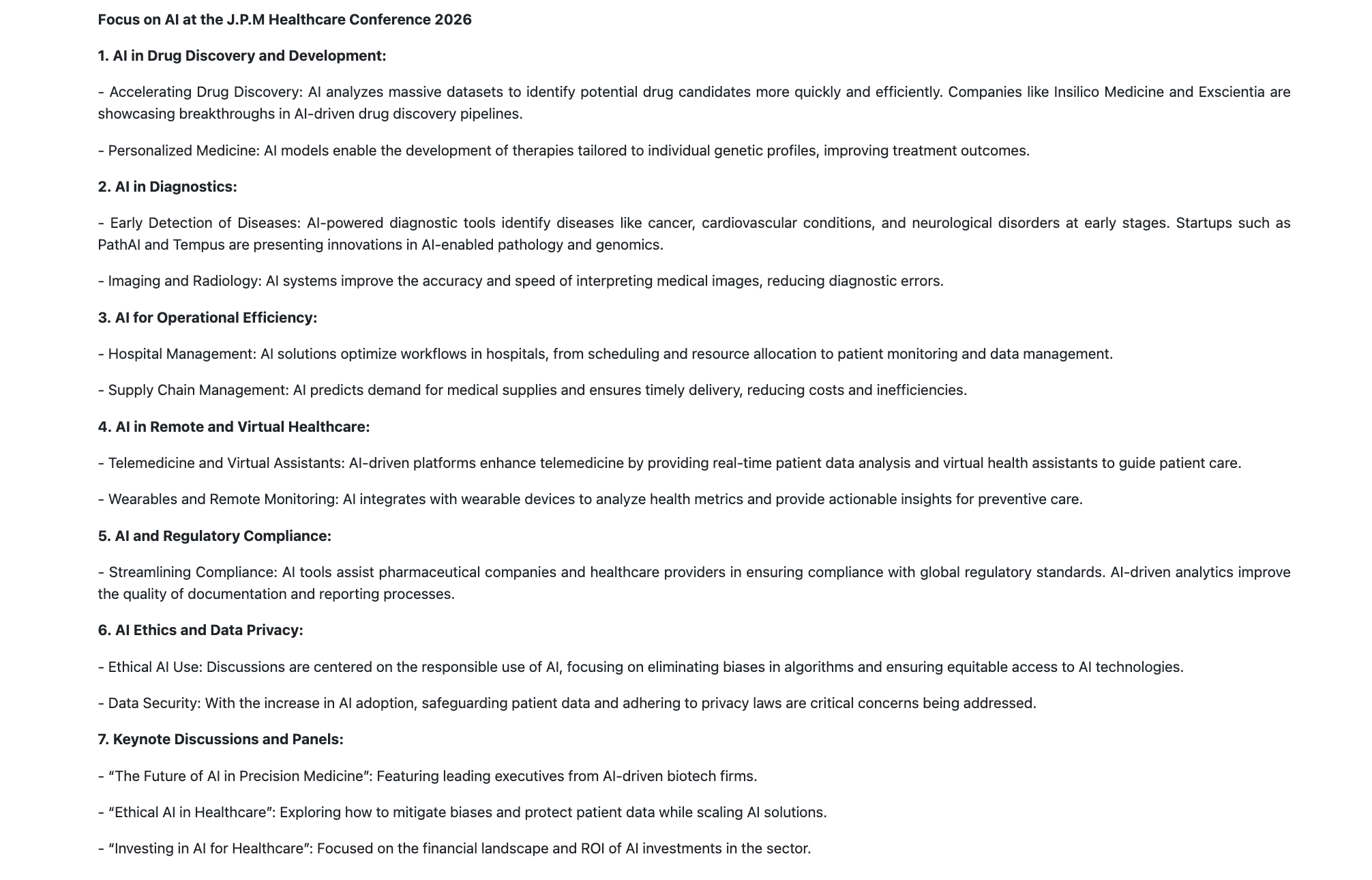
Isn’t this strange? Surely, you must feel the same thing as me, the inescapable suspicion that the whole show is being put on by an unconscious Chinese Room, its only job to pass over semi-legible symbols over to us with no regards as to what they actually mean. In fact, this pattern is consistent across not only how the conference communicates itself, but also how biopharmaceutical news outlets discuss it.
Each year, Endpoints News and STAT and BioCentury and FiercePharma all publish extensive coverage of the J.P. Morgan Healthcare Conference. I have read the articles they have put out, and none of it feels like it was written by someone who actually was at the event. There is no emotional energy, no personal anecdotes, all of it has been removed, shredded into one homogeneous, smoothie-like texture. The coverage contains phrases like “pipeline updates” and “strategic priorities” and “catalysts expected in the second half.” If the writers of these articles ever approach a human-like tenor, it is in reference to the conference’s “tone”. The tone is “cautiously optimistic.” The tone is “more subdued than expected.” The tone is “mixed.” What does this mean? What is a mixed tone? What is a cautiously optimistic tone? These are not descriptions of a place. They are more accurately descriptions of a sentiment, abstracted from any physical reality, hovering somewhere above the conference like a weather system.
I could write this coverage. I could write it from my horrible apartment in New York City, without attending anything at all. I could say: “The tone at this year’s J.P. Morgan Healthcare Conference was cautiously optimistic, with executives expressing measured enthusiasm about near-term catalysts while acknowledging macroeconomic headwinds.” I made that up in fifteen seconds. Does it sound fake? It shouldn’t, because it sounds exactly like the coverage of a supposedly real thing that has happened every year for the last forty-four years.
Speaking of the astral body I mentioned earlier, there is an interesting historical parallel to draw there. In 1835, the New York Sun published a series of articles claiming that the astronomer Sir John Herschel had discovered life on the moon. Bat-winged humanoids, unicorns, temples made of sentient sapphire, that sort of stuff. The articles were detailed, describing not only these creatures appearance, but also their social behaviors and mating practices. All of these cited Herschel’s observations through a powerful new telescope. The series was a sensation. It was also, obviously, a hoax, the Great Moon Hoax as it came to be known. Importantly, the hoax worked not because the details were plausible, but because they had the energy of genuine reporting: Herschel was a real astronomer, and telescopes were real, and the moon was real, so how could any combination that involved these three be fake?
To clarify: I am not saying the J.P. Morgan Healthcare Conference is a hoax.
What I am saying is that I, nor anybody, can tell the difference between the conference coverage and a very well-executed hoax. Consider that the Great Moon Hoax was walking a very fine tightrope between giving the appearance of seriousness, while also not giving away too many details that’d let the cat out of the bag. Here, the conference rhymes.
For example: photographs. You would think there would be photographs. The (claimed) conference attendees number in the thousands, many of them with smartphones, all of them presumably capable of pointing a camera at a thing and pressing a button. But the photographs are strange, walking that exact snickering line that the New York Sun walked. They are mostly photographs of the outside of the Westin St. Francis, or they are photographs of people standing in front of step-and-repeat banners, or they are photographs of the schedule, displayed on a screen, as if to prove that the schedule exists. But photographs of the inside with the panels, audience, the keynotes in progress; these are rare. And when I do find them, they are shot from angles that reveal nothing, that could be anywhere, that could be a Marriott ballroom in Cleveland.
Is this a conspiracy theory? You can call it that, but I have a very professional online presence, so I personally wouldn’t. In fact, I wouldn’t even say that the J.P. Morgan Healthcare Conference is not real, but rather that it is real, but not actually materially real.
To explain what I mean, we can rely on economist Thomas Schelling to help us out. Sixty-six years ago, Schelling proposed a thought experiment: if you had to meet a stranger in New York City on a specific day, with no way to communicate beforehand, where would you go? The answer, for most people, is Grand Central Station, at noon. Not because Grand Central Station is special. Not because noon is special. But because everyone knows that everyone else knows that Grand Central Station at noon is the obvious choice, and this mutual knowledge of mutual knowledge is enough to spontaneously produce coordination out of nothing. This, Grand Central Station and places just like it, are what’s known as a Schelling point.
Schelling points appear when they are needed, burnt into our genetic code, Pleistocene subroutines running on repeat, left over from when we were small and furry and needed to know, without speaking, where the rest of the troop would be when the leopards came. The J.P. Morgan Healthcare Conference, on the second week of January, every January, Westin St. Francis, San Francisco, is what happened when that ancient coordination instinct was handed an industry too vast and too abstract to organize by any other means. Something deep drives us to gather here, at this time, at this date.
To preempt the obvious questions: I don’t know why this particular location or time or demographic were chosen. I especially don’t know why J.P. Morgan of all groups was chosen to organize the whole thing. All of this simply is.
If you find any of this hard to believe, observe that the whole event is, structurally, a religious pilgrimage, and has all the quirks you may expect of a religious pilgrimage. And I don’t mean that as a metaphor, I mean it literally, in every dimension except the one where someone official admits it, and J.P. Morgan certainly won’t.
Consider the elements. A specific place, a specific time, an annual cycle, a journey undertaken by the faithful, the presence of hierarchy and exclusion, the production of meaning through ritual rather than content. The hajj requires Muslims to circle the Kaaba seven times. The J.P. Morgan Healthcare Conference requires devotees of the biopharmaceutical industry to slither into San Francisco for five days, nearly all of them—in my opinion, all of them—never actually entering the conference itself, but instead orbiting it, circumambulating it, taking coffee chats in its gravitational field. The Kaaba is a cube containing, according to tradition, nothing, an empty room, the holiest empty room in the world. The Westin St. Francis is also, roughly, a cube. I am not saying these are the same thing. I am saying that we have, as a species, a deep and unexamined relationship to cubes.
This is my strongest theory so far. That the J.P. Morgan Healthcare conference isn’t exactly real or unreal, but a mass-coordination social contract that has been unconsciously signed by everyone in this industry, transcending the need for an underlying referent.
My skeptical readers will protest at this, and they would be correct to do so. The story I have written out is clean, but it cannot be fully correct. Thomas Schelling was not so naive as to believe that Schelling points spontaneously generate out of thin air, there is always a reason, a specific, grounded reason, that their concepts become the low-energy metaphysical basins that they are. Grand Central Station is special because of the cultural gravitas it has accumulated through popular media. Noon is special because that is when the sun reaches its zenith. The Kaaba was worshipped because it was not some arbitrary cube; the cube itself was special, that it contained The Black Stone, set into the eastern corner, a relic that predates Islam itself, that some traditions claim fell from heaven.
And there are signs, if you know where to look, that the underlying referent for the Westin St. Francis status being a gathering area is physical. Consider the heat. It is January in San Francisco, usually brisk, yet the interior of the Westin St. Francis maintains a distinct, humid microclimate. Consider the low-frequency vibration in the lobby that ripples the surface of water glasses, but doesn’t seem to register on local, public seismographs. There is something about the building itself that feels distinctly alien. But, upon standing outside the building for long enough, you’ll have the nagging sensation that it is not something about the hotel that feels off, but rather, what lies within, underneath, and around the hotel.
There’s no easy way to sugarcoat this, so I’ll just come out and say it: it is possible that the entirety of California is built on top of one immensely large organism, and the particular spot in which the Westin St. Francis Hotel stands—335 Powell Street, San Francisco, 94102—is located directly above its beating heart. And that this is the primary organizing focal point for both the location and entire reason for the J.P. Morgan Healthcare Conference.
I believe that the hotel maintains dozens of meter-thick polyvinyl chloride plastic tubes that have been threaded down through the basement, through the bedrock, through geological strata, and into the cardiovascular system of something that has been lying beneath the Pacific coast since before the Pacific coast existed. That the hotel is a singular, thirty-two story central line. That, during the week of the conference, hundreds of gallons of drugs flow through these tubes, into the pulsating mass of the being, pouring down arteries the size of canyons across California. The dosing takes five days; hence the length of the conference.
And I do not believe that the drugs being administered here are simply sedatives. They are, in fact, the opposite of sedatives. The drugs are keeping the thing beneath California alive. There is something wrong with the creature, and a select group of attendees at the J.P. Morgan Healthcare Conference have become its primary caretakers.
Why? The answer is obvious: there is nothing good that can come from having an organic creature that spans hundreds of thousands of square miles suddenly die, especially if that same creatures mass makes up a substantial portion of the fifth-largest economy on the planet, larger than India, larger than the United Kingdom, larger than most countries that we think of as significant. Maybe letting the nation slide off into the sea was an option at one point, but not anymore. California produces more than half of the fruits, vegetables, and nuts grown in the United States. California produces the majority of the world’s entertainment. California produces the technology that has restructured human communication. Nobody can afford to let the whole thing collapse.
So, perhaps it was decided that California must survive, at least for as long as possible. Hence Amgen. Hence Genentech. Hence the entire biotech revolution, which we are taught to understand as a triumph of science and entrepreneurship, a story about venture capital and recombinant DNA and the genius of the California business climate. The story is not false, but incomplete. The reason for the revolution was, above all else, because the creature needed medicine, and the old methods of making medicine were no longer adequate, and someone decided that the only way to save the patient was to create an entire industry dedicated to its care.
Why is drug development so expensive? Because the real R&D costs are for the primary patient, the being underneath California, and human applications are an afterthought, a way of recouping investment. Why do so many clinical trials fail? For the same reason; the drugs are not meant for our species. Why is the industry concentrated in San Francisco, San Diego, Boston? Because these are monitoring stations, places where other intravenous lines have been drilled into other organs, other places where the creature surfaces close enough to reach.
Finally, consider the hotel itself. The Westin St. Francis was built in 1904, and, throughout its entire existence, it has never, ever, even once, closed or stopped operating. The 1906 earthquake leveled most of San Francisco, and the Westin St. Francis did not fall. It was damaged, yes, but it did not fall. The 1989 Loma Prieta earthquake killed sixty-three people and collapsed a section of the Bay Bridge. Still, the Westin St. Francis did not fall. It cannot fall, because if it falls, the central line is severed, and if the central line is severed, the creature dies, and if the creature dies, we lose California, and if we lose California, our civilization loses everything that California has been quietly holding together. And so the Westin St. Francis has hosted every single J.P. Morgan Healthcare Conference since 1983, has never missed one, has never even come close to missing one, and will not miss the next one, or the one after that, or any of the ones that follow.
If you think about it, this all makes a lot of sense. It may also seem very unlikely, but unlikely things have been known to happen throughout history. Mundus Subterraneus had a section on the “seeds of metals,” a theory that gold and silver grew underground like plants, sprouting from mineral seeds in the moist, oxygen-poor darkness. This was wrong, but the intuition beneath it was not entirely misguided. We now understand that the Earth’s mantle is a kind of eternal engine of astronomical size, cycling matter through subduction zones and volcanic systems, creating and destroying crust. Athanasius was wrong about the mechanism, but right about the structure. The earth is not solid. It is everywhere gaping, hollowed with empty rooms, and it is alive.
Love how this became so speculative and unhinged the further you read. Very topical as we were just sitting in the office talking about how none of us have ever been inside JPM - just orbiting it taking meetings and going to after parties and happy hours
love your writing, pls tell me you’re planning to publish a book one day