

Note: Extraordinarily grateful to Milan Cvitkovic, Sumner Norman, Ben Woodington, and Adam Marblestone for all the helpful conversations, comments, and critiques on drafts of this essay.
Second note: I am co-hosting an NYC Biotech x ML meetup on Feb 11th, here is the link.
Introduction
Neurotech is complicated. This is because you need to understand at least five fields at once to actually grasp what is/isn’t possible: electrical engineering, mechanical engineering, biology, neuroscience, and computer science. And, if you’re really trying to cover all the bases: surgery, ultrasound and optical physics as well. And I’ve met relatively few people in my life who can operate at the intersection of three fields, much less eight! As a result, I’ve stayed away from the entire subject, hoping that I’d eventually learn what’s going on via osmosis.
This has not worked. Each time a new neurotech startup comes out, I’d optimistically chat about them with some friend in the field and they inevitably wave it off for some bizarre reason that I would never, ever understand. But the more questions I asked, the more confused I would get. And so, at a certain point, I’d just start politely nodding to their ‘Does that make sense?’ questions.
I have, for months, been wanting to write an article to codify the exact mental steps these people go through when evaluating these companies. After talking to many experts, I have decided that this is a mostly impossible task, but that there are at least a few, small, legible fractions of their decision-making framework that are amenable to being written out. This essay is the end result.
My hope is that this helps set up the mental scaffolding necessary to triage which approaches are tractable, and which ones are more speculative. Obviously, take all of my writing with a grain of salt; anything that touches the brain is going to be complicated, and while I will try to offer as much nuance as possible, I cannot promise I will offer as much as an Actual Expert can. Grab coffee with your local neurotech founder!
Questions
How relevant are the state measurements to the application?
At least some forms of neurotech, like brain-computer-interfaces, perform some notion of ‘brain state reading’ as part of their normal functionality.
Well, what exactly is ‘brain state’?
Unfortunately for us, ‘brain state’ lies in the same definitional scope as ‘cell state’. As in, there isn’t really a great ground truth for the concept. But there are things that we hope are related to it! For cells, those are counts of mRNA, proteins found, chromatin landscape of the genome, and so on. For brains, there are four main possibilities to get at a notion of state:
Measure the spiking activity of singular neurons (very invasive)
Measure the activity of local field potentials (can be slightly less invasive)
Measure hemodynamics (blood flow or oxygenation) changes (can be non-invasive, though higher-res invasive)
Measure electromagnetic fields outside the skull (usually non-invasive)
There is an ordering here; at the top, we have measurements that are closest to the actual electrical signaling that (probably) defines moment-to-moment neural computation. As we move down the list, each method becomes progressively more indirect, integrating over larger populations of neurons, longer time windows, and/or more layers of intermediary physiology.
This is perhaps overcomplicating things, but there’s one also, slightly more exotic approach not mentioned here (and that I won’t mention again), called biohybrid devices. In these systems, neurons grown ex-vivo are engrafted to a brain, and those neurons are measured directly, so it’s sort of an aggregate measure like LFP, but also it’s technically able to measure single spikes.
But keep in mind: none of these actually work at understanding the full totality of every single neuron firing in a brain, which is a largely physically intractable thing to perform. Which is fine and fair! Understanding totalities is a tall bar to meet. But it does mean that whenever we stumble across a new company, we should ask the question: how relevant is their method of understanding brain state to the [therapeutic area] they actually care about? Superficial cortical hemodynamics won’t reveal hippocampal spiking, 2-channel EEG won’t decode finger trajectories, and so on.
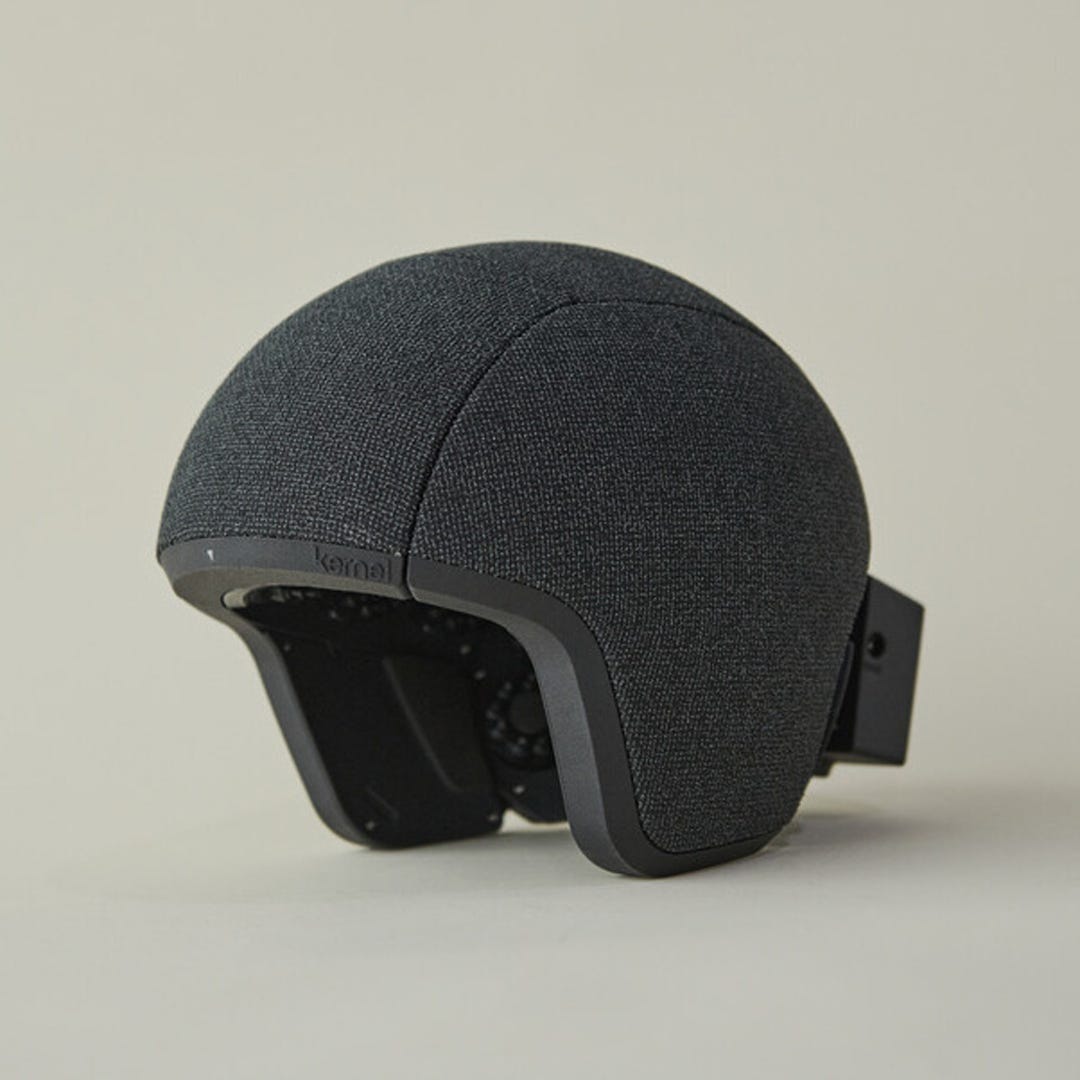
With this context, let’s consider Kernel, a neurotech company founded by the infamous Bryan Johnson in the mid-2010’s. Their primary product is called Kernel Flow, a headset that does time-domain functional near-infrared spectroscopy (TD-fNIRS) to measure brain state, which tracks blood oxygenation by measuring how light scatters through the skull. In other words, this is a hemodynamics measurement device.
It is non-invasive, portable, and looks like a bike helmet (which is an improvement compared to many other neurotech headsets!).
One common thing you’ll find on most neurotech websites is a ‘spec sheet’ of their device. For most places, you’ll need to formally request it, but Kernel helpfully provides easy access to it here.
In it, they note that the device has an imaging rate of 3.76Hz, which means it’s taking a full hemodynamic measurement about every 266 milliseconds across the surface of the brain. This is fast in absolute terms, but slow on the level of (at least some) cognitive processes, which often unfold on the order of tens of milliseconds. For example, the neural signatures involved in recognizing a face or initiating a movement can happen in less than 100 milliseconds. And to be clear, this is not something that can be altered by increasing the sampling rate; the slowness is inherent to hemodynamic measurements in general.
This means that by the time Flow finishes one hemodynamic snapshot, many of the neural events we care about have started and finished.
The spec sheet also notes that the device comes with 4 EEG electrodes, which have a far higher sampling rate of 1kHZ, or 1,000 measurements per second. At first glance, this seems like it might compensate for the sluggish hemodynamic signal by offering access to fast electrical activity. But in practice, 4 channels are entirely insufficient for learning really anything about the brain. Keep in mind that clinical-grade usually operates at the 32-channel-and-above level!
I found one paper that investigated the localization errors of EEG’s—as in, can you correctly place where in the brain a spike is occurring—across a range of channels: 256, 128, 64, 32, and 16. Not even 4! Yet, even at the 16-channel level, spatial localization was incredibly bad; one example of its failure case being that it mis-localized a temporal-lobe spike to the frontal lobe. Past that, noise like muscle and eye movement artifacts often dominates the EEG signal at the lowest channel counts.
And, again, this was on 16 channels! One can only imagine how much worse 4 channels is.
Of course, 4-channels of EEG data clearly offer something. In the context of the device, they may serve as a coarse sanity check or a minimal signal for synchronizing with the slower hemodynamic measurements. Which maybe is enough to be useful?
But we may be getting ahead of ourselves by getting lost in these details. It is entirely irrelevant to consider the absolute value of any given measurement decision being made here, because, again, what actually matters is the relevancy of those measurements to whatever the intended use case is. Clearly the devices measurements are, at least, trustworthy. But what is it meant to be used for?
Well…it’s vague. Kernel’s public messaging has shifted over the years—from “neuroenhancement” and “mental fitness” to, most recently, “brain biomarkers.”. I am not especially well positioned to answer whether this final resting spot is relevant to what Kernel is measuring, but it feels like it is? At least if you look at their publications, which do show that the device is capable of capturing global brain state changes when under the influence of psychoactive substances, e.g. ketamine. So, even if hemodynamics doesn’t meet the lofty goal of being able to detect face recognition, that’s fine! Static-on-the-order-of-minutes biomarkers are fully within their measuring purview.
Does that make Kernel useful? I don’t know the answer to that, but we’ll come back to the subject in a second.
What are the costs and burdens for the user?
In short: a device must earn its place in a patient's life.
The historical arc of neurotech companies lay mainly in serving desperate people that have literally no other options: ALS, severe spine damage, locked-in syndrome, and the like. The giants of the field—Synchron, Blackrock Neurotech, and Neuralink—have all positioned themselves around these, and so their maximally invasive nature is perfectly fine with their patients. Now, fairly, Synchron apparently doesn’t have the greatest reputation and Blackrock is somewhat old-fashioned, so Neuralink could be considered the only giant, but all three did pop up a lot during my research!
Blackrock Neurotech are the creators of the Utah Array, which remains the gold standard for invasive, in-vivo neural recording. Neuralink, the newest and most-hyped, have iterated on the approach, developing ultra-thin probes that can be inserted into the brain to directly record signals. Synchron has the least invasive approach, with its primary device being an endovascular implant called the Stentrode, allowing neural signals to be read less invasively than a Utah Array or Neuralink (from a blood vessel in the brain rather than in the parenchyma), though at a severe cost of signal quality.
You could find faults with these hyper-invasive neurotech companies on the basis of ‘how realistically large is the patient population?’, but you can’t deny that amongst the patient population that does exist, they’d certainly benefit!
So…if you do spot a neurotech company that is targeting a less-than-desperate patient population, you should ask yourself: why would anyone sign up for this? Why would an insurance company pay for it? And most importantly, why would the FDA ever approve something with such a lopsided risk-reward ratio? This is also why you see a lot of neurotech companies pivot toward “wellness” applications when their original clinical thesis doesn’t pan out. Wellness doesn’t require FDA approval or insurance reimbursement! But it also doesn’t require the device to actually work.
But even if a neurotech company is targeting a less-than-desperate patient population and aren’t trying to push them towards surgery, it’s still worth thinking about the burdens they pose!
Neurotech devices can be onerous in more boring ways too, so much so that they can completely kill any desire for any non-desperate person to use it. One example is a device we’ve talked about: the Kernel Flow. Someone who I chatted with for this essay mentioned that they had tried it, and had this to say about it:
“[the headset] weighs like 4.5lbs. That is so. fucking. uncomfortable.”.
Now, it may be the case that the information that the device tells you is of such importance that it is worth putting up with the discomfort. Is the Kernel Flow worth it? I don’t know, I haven’t tried it! But in case you ever do personally try one of these wellness-focused devices, it is worth pondering how big of a chore it’d be to deal with.
How much is the approach ‘fighting physics’?
Speaking of ‘building things for less desperate patients’, two big neurotech names that often come up are Nudge and Forest Neurotech (the founder of whom I talked to for this article, who has since moved to Merge Labs).
Both of these startups are focusing on brain stimulation for mental health, though Forest’s ambitions also include TBI and spinal cord injuries. Depression, anxiety, and PTSD can be quite awful, but only the most severely affected patients (single-digit percentages of the total patient population) would likely be willing to receive a brain implant. And both of these companies are fully aware of that, which is why neither of them do brain implants.
But, even if you aren’t directly placing wires into the brain, there is still some room to play with how invasive you actually are. I think it’d be a useful exercise to discuss both Nudge and Forest’s approaches—the former non-invasive, the latter invasive (albeit slightly less invasive than a Neuralink, which goes directly into the brain parenchyma)— because they illustrate an interesting dichotomy I’ve found amongst neurotech startups: the degree to which they are attempting to ‘fight’ physics.
At the more invasive end, there’s Forest Neurotech. Forest was founded in October 2023 by two Caltech scientists—Sumner Norman and Tyson Aflalo—alongside Will Biederman from Verily. They’re structured as a nonprofit Focused Research Organization and backed by $50 million from Eric and Wendy Schmidt, Ken Griffin, ARI, James Fickel, and the Susan & Riley Bechtel Foundation. Their approach relies on ultrasound, built on Butterfly Network’s ultrasound-on-chip technology, that sits inside the skull but outside the brain’s dura mater; also called an ‘epidural implant’. Still invasive, but again, not touching the brain!
At the less invasive end, there’s Nudge, who just raised $100M back in July 2025 and has Fred Ehrsam, the co-founder of Coinbase, as part of the founding team. They also have an ultrasound device, but theirs is entirely non-invasive, and comes with a nice blog post to describe exactly what it is: …a high channel count, ultrasound phased array, packed into a helmet structure that can be used in an MRI machine.
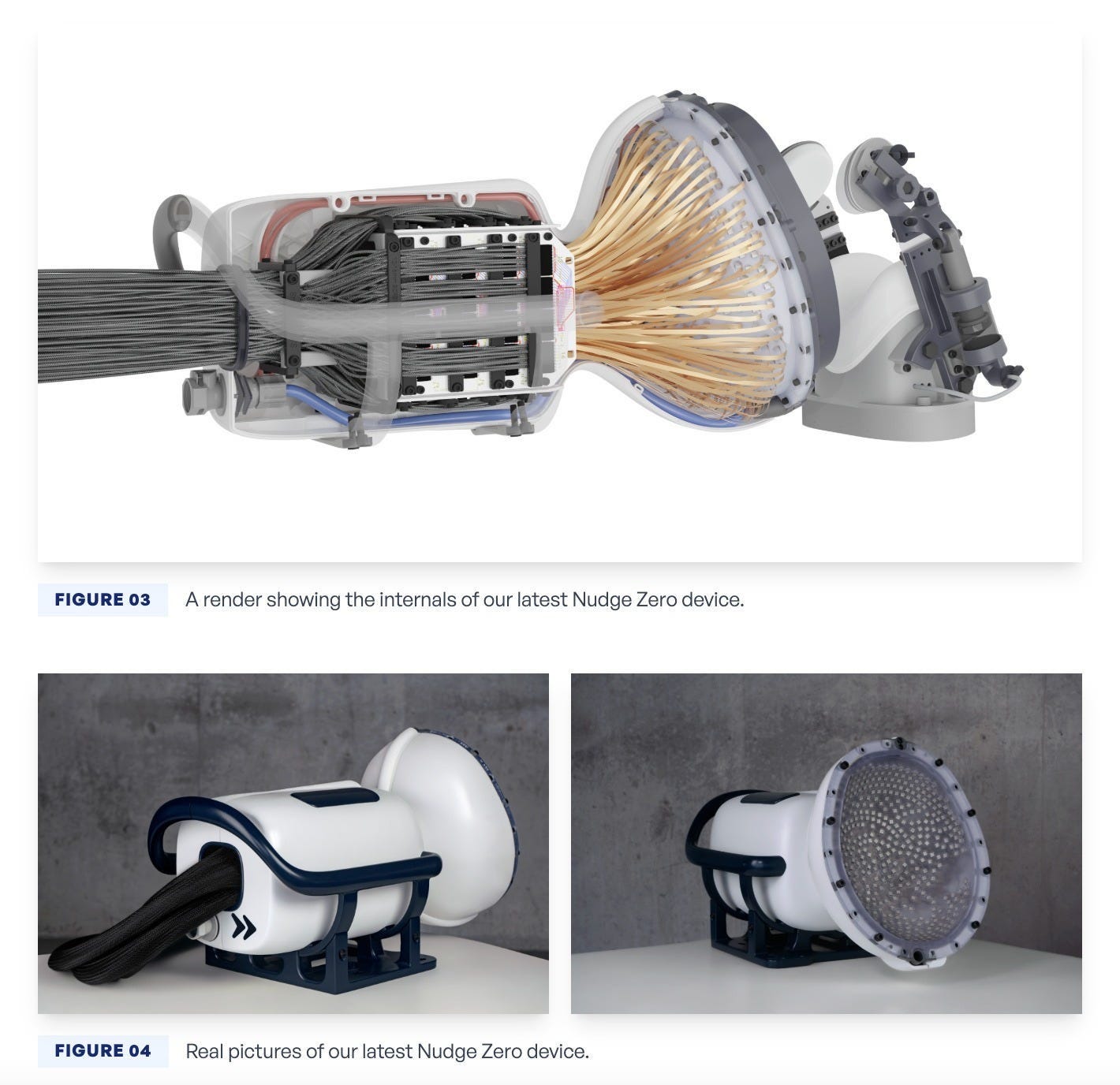
So, yes, both of these are essentially focused ultrasound devices meant for neural stimulation, though I should add the nuance that Forest’s device is also capable of imaging. But, despite the surface similarities, one distinct split between the two is that, really, Nudge is attempting to fight physics a lot more than Forest.
Why? Because they must deal with the skull.
Nudge’s device works by sending out multiple ultrasound waves from an array of transducers that are timed so precisely that they constructively interfere at a single millimeter-scale point deep in the brain, stimulating a specific neuron population, usually millions of them. It is not dissimilar to the basic principle as noise-cancelling headphones, but in reverse: instead of waves cancelling each other out, they add up. The hope is that all the peaks of the waves arrive at the same spot at the same moment—constructive interference—and you get a region of high acoustic pressure that can change brain activity. As a sidepoint: you’d think this works by stimulating neurons! But apparently it can work both via stimulation or inhibition, depending on how the ultrasound is set up.
How is the Nudge approach fighting physics?
First, there’s absorption. The skull soaks up a substantial chunk of the emitted ultrasound energy and converts it into heat. One study found that the skull causes 4.7 to 7 times more attenuation than the scalp or brain tissue combined.
Second, aberration. Because the skull varies in thickness, density, and internal structure across its surface, different parts of your ultrasound wavefront travel at different speeds, so, by the time the waves reach the brain, they’re no longer in phase. If the whole point of focused ultrasound is getting all your waves to constructively interfere at a single point, the skull messes that up, and the intended focal spot gets smeared, shifted, or might not form properly at all.
And, finally, the skull varies enormously between individuals. The “skull density ratio”—a metric that captures how much trabecular (spongy) bone versus cortical (dense) bone you have—differs from person to person, and it dramatically affects how well ultrasound gets through.
Now, to be clear, Nudge is aware of all of these things, and the way they’ve structured their device is attempting to fight all these problems. For example, Nudge talks a fair bit about how their device is MRI-compatible. This is great! If you want to correct for aberrations (and for everyone’s brain being a different shape), you need to know what you’re correcting for, which means you need a detailed 3D model of that specific patient’s skull, which means you need an MRI (or better CT). You image the skull, you build a patient-specific acoustic model, you compute the corrections needed to counteract the distortions, and then you program those corrections into your transducer array. Problem solved!
Well, maybe. Fighting physics is a difficult problem, and we’ll see what they come up with. While there is already a focused ultrasound, FDA-approved device that has been used in thousands of surgeries similar to Nudge’s that can target the brain with millimeter-scale accuracy (albeit for ablating brain tissue, not stimulating it, but the physics are the same!), it is an open question whether Nudge can dramatically improve on the precision and convenience needed to make it useful for mental health applications.
On the other hand, Forest, by bypassing the skull, is almost certainly assured to hit the brain regions they most want, potentially reaching accuracies at the micron scale. Remember that these differences cube, i.e. the number of neurons in a 150 micron wide voxel vs. a 1.5 millimeter wide voxel is (1500^3)/(150^3) =1,000 times more neurons. So it’s safe to say that the Forest device is, theoretically, 2-3 orders of magnitude more precise in the volumes it interacts with than Nudge is. Now, Forest still isn’t exactly an easy bet, given that they now have to power something near an organ that really, really doesn’t like to get hot, figure out implant biocompatibility, and a bunch of other problems that come alongside invasive neurotech devices. But they at least do not have to fight the skull, and are thus assured a high degree of precision.
There is, of course, a reward for Nudge’s trouble. Nudge, if they succeed, also gets access to a much larger potential patient population, since no surgery is needed. This is opposed to Forest, who must limit themselves to a smaller, more desperate demographic.
As with anything in biology, there is an immense amount of nuance I am missing in this explanation. People actually in the neurotech field are likely at least a little annoyed with the above explanation, because it does leave out something important in this Nudge versus Forest, non-invasive versus invasive, physics-fighting versus physics-embracing debate: how much does it all matter anyway?
Do they know whether their advantages translates to clinical benefit?
The brain computer interface field is in a strange epistemic position where devices are being built to modulate brain regions whose exact anatomical boundaries aren’t agreed on (and may even diverge between individuals!), using mechanisms that aren’t fully understood, for conditions whose neural circuits are still being studied.
Because of this, despite all the problems I’ve listed out with going through the skull, Nudge will almost certainly have some successful clinical readouts. Why? It has nothing to do with the team at Nudge being particularly clever, but rather, because there is already existing proof that non-invasive ultrasound setups somehow work for some clinically relevant objectives.
Nudge is fun to refer to because they have a lot of online attention on them, but there are other players in the ultrasound simulation space too, ones who are more public with their clinical results. SPIRE Therapeutics is one such company and they, or at least people associated with the company (Thomas S Riis), have papers demonstrating tremor alleviation (n=3), chronic pain reduction (n=20), and, most relevant to this whole discussion, and depressive symptom improvement (n=22 + randomized + double-blind!), all using their noninvasive ultrasound device.
How is this possible? How do these successful results square with the skull problems from earlier?
Clearly, something is getting through the skull, and it seems to be having some clinically significant effect. Because of this, it could very well be possible that the relative broadness of Nudge’s and SPIRE’s (and others like them) stimulation is, in fact, perfectly fine, and being incredibly precise is simply not worth the effort. This all said, it is hard to give Forest a fair trial here, since they are basically the only ones going the invasive route for ultrasound, and their clinical trials (which use noninvasive devices) have just started circa early 2025. Maybe their results will be spectacular, and I’d recommend watching Sumner’s (the prior Forest CEO) appearance on Ashlee Vance’s podcast to learn more about early results there.
But really, this debate between invasive and non-invasive really belongs in the previous section, because the point I am trying to make here is a bit more broad than these two companies. What I’m really gesturing at is that being really good at [X popular neurotech metric] doesn’t alone equal something better! This is as true for precision as it is for everything else.
Staying on the example of precision, consider the absolute dumbest possible way you could approach brain stimulation: simply wash the entire brain with electricity and hope for the best.
This is, more or less, what electroconvulsive therapy (ECT) does. Electrodes are placed on your scalp, a generalized seizure is induced, and you repeat this a few times a week. You are, in the most literal sense, overwhelming the entire brain with synchronized electrical activity. And yet despite the insane lack of specificity, ECT remains the single most effective treatment we have for severe, treatment-resistant depression. Response rates hover around 50-70% in patients for whom nothing else has worked, with some rather insane outcomes, one review paper stating: “For the primary outcome of all-cause mortality, ECT was associated with a 30% reduction in overall mortality.” For some presentations, like depression with psychotic features, catatonia, or acute suicidality, it is essentially first-line.
This should be deeply humbling for anyone looking into the neuromodulation space. There are companies raising hundreds of millions of dollars to hit specific brain targets with millimeter, even micron precision, and meanwhile, the most effective neurostimulation-for-depression approach we’ve ever discovered involves no targeting whatsoever. Now, of course, there are genuine downsides to the ECT approach (cognitive side effects, the need for anesthesia, the inconvenience of repeated hospital visits, obviously doesn’t work for every neuropsychiatric disorder) that make it worth pursuing alternatives! But it does suggest that the relationship between targeting precision and clinical outcome is much more complex than you’d otherwise assume.
Consider the opposite failure mode. Early deep brain stimulation—the most spatiotemporally precise neurostimulation method currently available—trials for depression are instructive here. Researchers identified what they believed was “the depression circuit,” implanted electrodes in that exact area, delivered stimulation, and then watched as several major trials burned tens of millions of dollars on null results. Most infamously, the BROADEN trial, targeting the subcallosal cingulate, and the RECLAIM trial, targeting the ventral capsule/ventral striatum, both of which failed their primary endpoints.
Yet, DBS is FDA-approved for Parkinson’s treatment and is frequently used to treat OCD. Each indication is a world unto itself in how amenable it is ‘precision’ being a useful metric.
But again, this point extends beyond precision.
As a second example, consider the butcher number, a metric first coined by the Caltech neuroscientist Markus Meister, which captures the ratio of the number of neurons destroyed for each neuron recorded. Now, you’d ideally like to reduce the butcher number, because killing neurons is (probably) bad. And one way you could reliably reduce the butcher number is by simply making your electrodes thinner and more flexible. This is, more or less, at least part of Neuralink’s thesis: their polymer threads are 5 to 50 microns wide and only 4 to 6 microns thick (dramatically smaller than the Utah array’s 400-micron-diameter electrodes!) and thus almost certainly has a low butcher number.
Here’s the Neuralink implant:
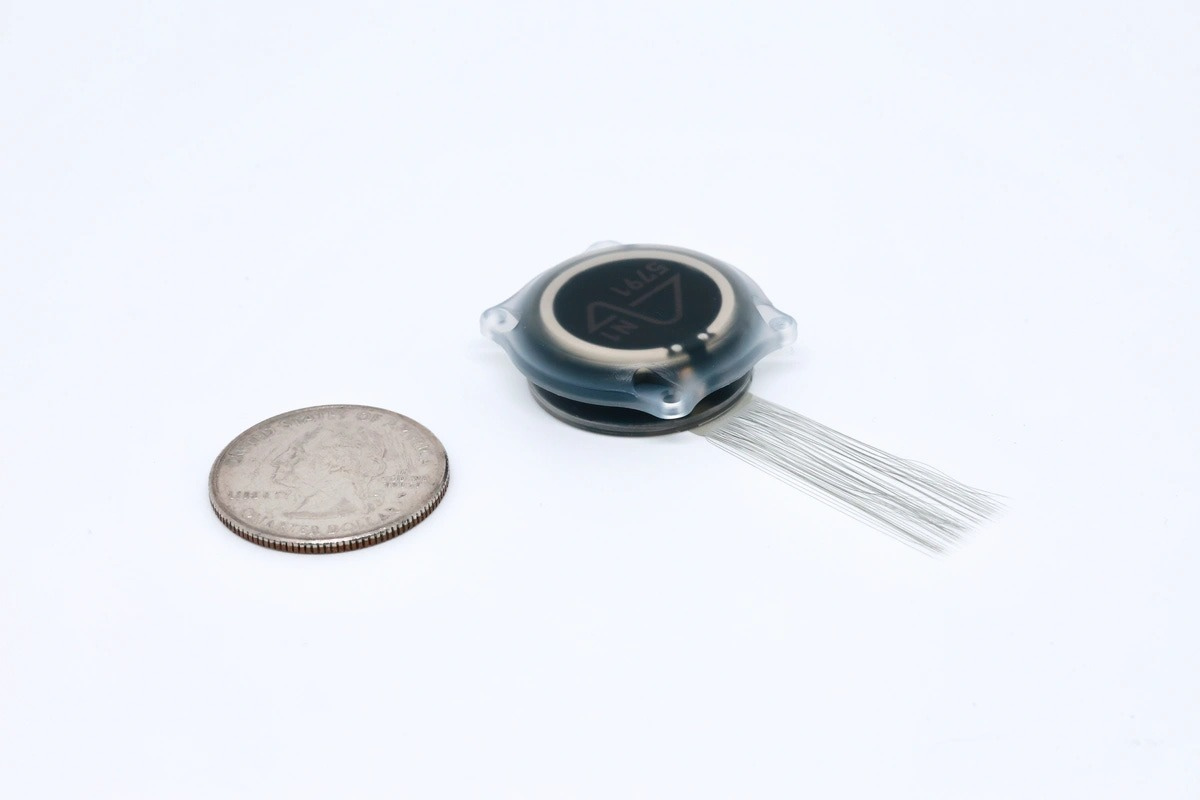
And here’s the Utah array:
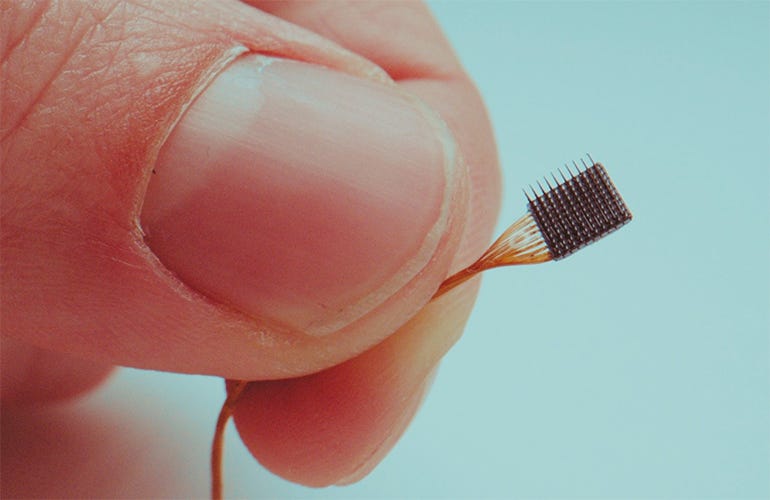
But does having a lower butcher number actually translate to better clinical outcomes? As far as I can tell, nobody knows! It’s largely unstudied! It’s conceivable that yes, lowering this number is useful, but surely there is a point where the priority of the problem dramatically drops compared to the litany of other small terrors that plague most neurotech startups.
The point here is not that the butcher’s number is useless. The point also isn’t that precision is useless. The point is that the relationship between any given engineering metric and clinical success (in your indication) is rarely as straightforward as anyone hopes, and it’s worth considering whether that relationship has actually been established before believing that success on the metric is at all useful.
Could this be done without touching the central nervous system?
Finally: something that repeated across the neurotech folks I talked to was that people consistently underestimate how extraordinarily adaptable the peripheral nervous system is. For example, a company that claims to, say, automatically interpret commands to a digital system via EEG should probably make absolutely certain that attaching an electromyography device to a person’s forearm (and training them to use it) wouldn’t wind up accomplishing the exact same thing.
In fact, there was a company that did exactly this. Specifically, CTRL-labs, a New York City-based startup. They came up over and over again in my conversations as a prime example of someone solving something very useful, in a way that completely avoided the horrifically challenging parts of touching the brain. Their device was a simple wristband that reads neuromuscular signals from the wrist (via electromyography, or EMG) to control external devices. Here’s a great video of it in action.
Now, if CTRL-labs was so great, what happened to their technology? They were acquired by Meta in 2019, joining Facebook Reality Labs. And if you look at the ex-CEO’s Twitter (who is now a VP at Meta), you can see that he recently retweeted a September 2025 podcast with Mark Zuckerberg, in which Mark says that their next generation of glasses will include an EMG band capable of allowing you to type, hands free, purely by moving your facial muscles.
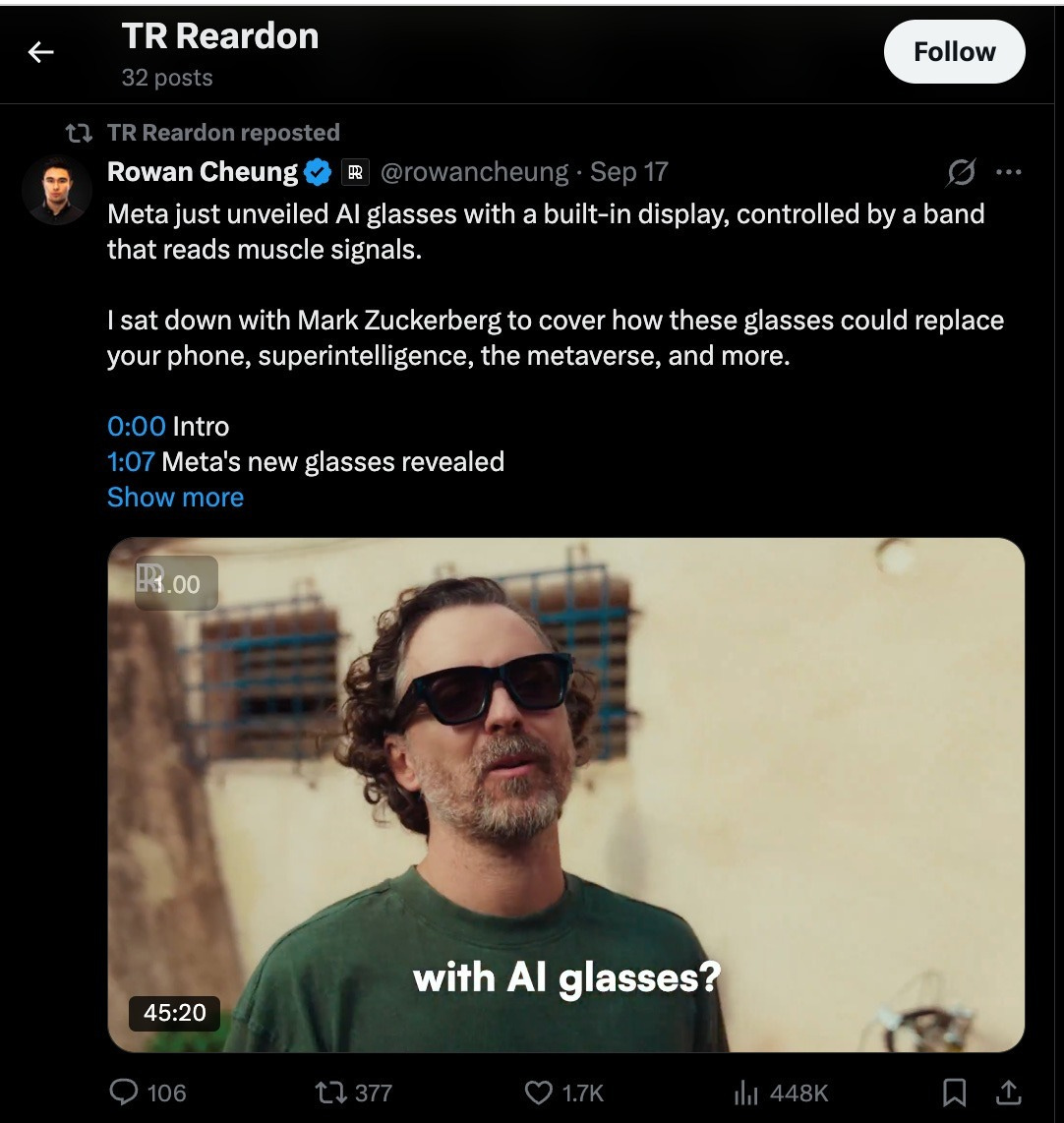
Not too far of a stretch to imagine that this is based on CTRL-labs work! And, by the time I finally finished this essay, the device now has a dedicated Meta page!
What about something that exists today?
Another startup that multiple people were exuberant over was one called Augmental. Their device is something called ‘Mouthpad^’, and a blurb from the site best describes it:
The MouthPad^ is smart mouthwear that allows you to control your phone, computer, and tablet hands-free. Perched on the roof of your mouth, the device converts subtle head and tongue gestures into seamless cursor control and clicks. It’s virtually invisible to the world — but always available to you.
And here’s a wild video of a 19-year old quadriplegic using this device to interact with a computer and even code.
Isn’t this insane? I remember being shocked by the Neuralink demo videos showing paralyzed patients controlling cursors on screens. But this is someone doing essentially the same thing! All by exploiting both the tongue, which happens to have an extremely high density of nerve endings and remarkably fine motor control, and our brain, which can display remarkable adaptivity to novel input/output channels.
Now, fairly enough, a device like Augmental cannot do a lot of things. For someone with complete locked-in syndrome, there really may be no alternative to inserting a wire into the brain. And in the limit case of applications that genuinely require reading (or modifying!) the content of thought, the periphery again won’t cut it. But for a surprising range of use cases, the peripheral route seems to offer a dramatically better risk-reward tradeoff, and it feels consistently under-appreciated when people are mentally pricing how revolutionary a new neurotech startup is.
Conclusion
This piece has been in production for the last five months and, as such, lots of discarded bits of it can be found on the cutting room floor. There are lots of other things, not mentioned in this essay, that I think are also worth really pondering, but I couldn’t come up with a big, universal statement about what the takeaway is, or the point is pretty specific to a small subset of devices. I’ve attached three such things in the footnotes.1
Before ending, I’d like to repeat the sentiment I mentioned at the start: this field is complicated. A lot of the readers of this blog come from the more cell-biology or drug-discovery side of the life-sciences field, and may naturally assume that they can safely use that mental framework to grasp the neurotech field. I once shared this optimism, but I no longer do. After finishing this essay, I now believe that the relevant constraints in this domain come from such an overwhelming number of directions that it bears little resemblance to most other questions in biology, and more-so resembles the assessment of a small nation’s chances of surviving a war. The personality required to perform such a feat matches up with the archetype of individual I’ve found to work in this field, all of whom display a startling degree of scientific omniscience that, in any other field, would be considered extraordinary, but here is equivalent to competence. It would be impossible to recreate these people’s minds in anything that isn’t a seven-hundred-page text written in ten-point font, but I hope this essay serves as a rough first approximation.
Think about how they are powering the device. Brains really, really don’t like heat. The FDA limit is that an implant in or touching the brain can rise at most 1C above the surrounding tissue. So, if a device is promising to do a lot of edge compute and is even slightly invasive, it is worth being worried about this.
Think about whether they are closed-loop or open-loop. An open-loop technology intervenes on the brain without taking brain state into account, like ECT or Prozac. A closed-loop device reads neural activity and adjusts its intervention in real-time. Many companies gesture toward closed-loop as a future goal without explaining how they’ll get there. You may think that this should lead one to being especially optimistic about devices that can easily handle both reading and writing at the same time, because the pathway to closed-loop is technically much cleaner. But again, how much does ‘continuous closed loop’ matter, as opposed to a write-only device that is rarely calibrated via an MRI? Nobody knows!
Think about how they plan to deal with the specter of China’s stranglehold on the parts they need, and their rapidly advancing neurotech industry. This is a surprisingly big problem, and while there is almost certainly plenty of material here for its own section, I ended up not feeling super confident about the takeaway message here. Free article idea for those reading!
And there’s almost certainly a lot more that I’m not even thinking about, because I’m just not aware of it.
As a long time reader who is deeply interested in neurotech I loved this post! A few thoughts
1. You are 100% correct in saying that many of the results from companies like Neuralink or BlackRock Neurotech can be done without touching the Central Nervous System, with simple devices like the Mouthpad. This is something I quickly realized a few years ago when I was doing research on Neuralink. I'm conflicted on whether or not to count this as a point against Neuralink. On one hand, products like Telepathy weren't made to help locked-in users move a cursor but were made as a stepping stone to advance the company towards a "Holy Grail" device that lets humans merge with AIs. This focus on the "Holy Grail" is why things like the butcher number matter - though killing a few thousand neurons now doesn't really matter, eventually we'd want to scale from just a few thousand channels to hundreds or even millions of channels and it won't do to be killing a significant portion of the brain's total neurons. On the other hand, the company had a top tier team, billions of VC funding, and a decade to work with, and hasn't delivered better outcomes than a tonguepad / eye-tracking device could accomplish. Though to be fair, they are now working on a device that will attempt to restore vision in blind patients.
2. Though Nudge's approach of using Low-Intensity Focused ultrasound is a few orders of magnitude less precise than Forest Neurotech's approach, it not only several orders of magnitude more precise than basically every other non-invasive neuromodulation method, but is the only non-invasive neuromodulation technique that can reach deep into the brain. Why is this significant? You mentioned that using deep brain stimulation (an expensive and invasive procedure that involves physically inserting electrodes next to the desired target region), on theorized depression circuits, researchers burned tens of millions of dollars to achieve null results. With a Nudge-like device using LIFU, it would be possible to run such trials with a fraction of the time and cost, due to Low-Intensity Focused Ultrasound's non-invasiveness and relative safeness. A Nudge-Like device will significantly reduce the barriers to not only run such studies, but to map the entire brain.
3. You're definitely right about the market need for many modern neurotech devices. On one hand you have the medical grade devices from companies like BlackRock/Neuralink/Synchron/Precision Neurosciences, which serve a desperate but small population. As you've mentioned before, many of these people could be served equally well with a device that interacts with the Peripheral Nervous system instead. On the other hand you have the "Wellness" devices that are often just not very good.... There are so many EEG companies that are forever reaching but falling short of Product Market Fit. I don't know much about the Kernel Flow but it doesn't sound like a hyper successful consumer product. Yet, there are companies that have seen a lot of success in this space like Mouthpad and CNTRL-Labs, and two others whom I think will do VERY well in the consumer market if the product works: Orbit and Prophetic.
Anyways, loved the article. Your writing is some of the best on substack.
I thoroughly enjoyed the post! It comes at a time where I have spent quite some time thinking about neurotech and so there is a lot on my mind...
Part of the beauty is how you approach the space in the first place It seems many folks in the field make quite a few assumptions and continue about their work, and here you stop to say "Hey wait a minute, but what does this mean?"
---
After discussing your framework with some industry veterans (including folks working on next-gen ASICs and implants), I think there’s a 'hidden' sixth question that bridges your points on burden and physics:
1. The 'Delta of Effort' vs. Meaningful Utility
As one veteran pointed out to me, the ultimate test isn't just 'Does it work?' but 'Does it work meaningfully better than a mouthstick or eye-gaze?' We often get obsessed with the bandwidth of the signal (the physics), but we under-appreciate the cognitive and physical effort required to maintain that signal. If a non-invasive EEG or EMG device requires 2x the mental concentration for 1.1x the output of a simple mechanical interface, it fails the preference test every time.
Ultimately, a device must not only 'earn its place' in a patient’s life but it must do so with a lower 'tax' on their remaining energy than the existing hacks they’ve already mastered.
---
Your point about the 'relevancy of state measurements' is spot on, but I’m seeing an interesting counter-thesis emerge. While the 'physics' suggests EEG is a low-res mess (the 'fighting the skull' problem), I ask, what if we haven't actually hit the ceiling of EEG?
2. Challenging the 'EEG Ceiling'
If we treat scientific disciplines as artificial silos, we miss the fact that advanced ML models might unlock higher-dimensional insights from what we currently dismiss as 'raw noise.' We might be able to bypass some of the 'butcher number' dilemmas of invasive tech if we can extract 'invasive-grade' intent from 'non-invasive' signals through sheer computational brute force.
---
I’m glad you mentioned heat in the footnotes. In my recent conversations with founders, thermal management is becoming the real 'final boss' of invasive neurotech. The FDA’s 1 degree Celcius limit is a brutal constraint.
3. The Thermal Constraint: The Hardest Ceiling
It doesn't matter how many channels Neuralink or a startup like Mint Neuro can pack onto a chip if the power draw cooks the surrounding tissue. This makes the 'physics' question even more pointed: Are you fighting the skull (non-invasive), or are you fighting the Second Law of Thermodynamics (invasive)?
---
Just some thoughts, and I had no where else to dump them, but overall loved the post and definitely had a lot of fun reading it!