

Note: I’ve been traveling through Europe for the past week or so, and have not had time to finish my larger ongoing essays. So, this is a piece I wrote back in December 2025 about bioweapons programs. Also, a few friends and I are hosting an NYC meetup on July 16th, you should come by!
An ogre of a creature, something that had been born just weeks back, chewed on a padded rectangle. This rectangle was wirelessly connected to the tablet I was holding, and chirped that the bite force of whatever was gnawing at it hovered at roughly 4,700 PSI. That was the last thing I needed before I could finally hit the switch. The creature’s head vanished, replaced momentarily by a red aerosol and the sound of wet pennies hitting glass. Generally good practice to pack these things’ skulls with a plastic explosive when they first slide out of their birthing tank, because six-inch glass really isn’t tough enough to prevent one of these newer breeds from getting through to me, and replacing it with something seven-inch thick, or even a foot, just felt like kicking the can down the road.
I extracted the few biopsies I needed from the corpse, its body still gushing various gases from its various organs, and called in a cleaning crew. This one was Generation 47. I went through the checklist, compiling together a list of metrics to place into a slide-deck later. The cleaning crew arrived in their hazmat suits, spraying dissolving enzymes before the next iteration arrived. I handed one of them the vials containing my biopsies. “Could you hand this to the evolution team?” He laughed, a hearty, full guffaw, and told me to find some other idiot to be a messenger boy. I breathed in deeply and delivered it myself.
After arriving back at my observation chamber, I received a call from the external womb team, who told me that Generation 48 was on their way. I thanked them for the notification and hung up. I hated the external womb team. They had been given a budget of nearly $50B to keep the production line of this project moving as quickly as possible and it increasingly felt like the developmental biologists who ran the whole thing had long since abandoned the hope of doing anything useful, in pursuit of increasingly bizarre aesthetic modifications.
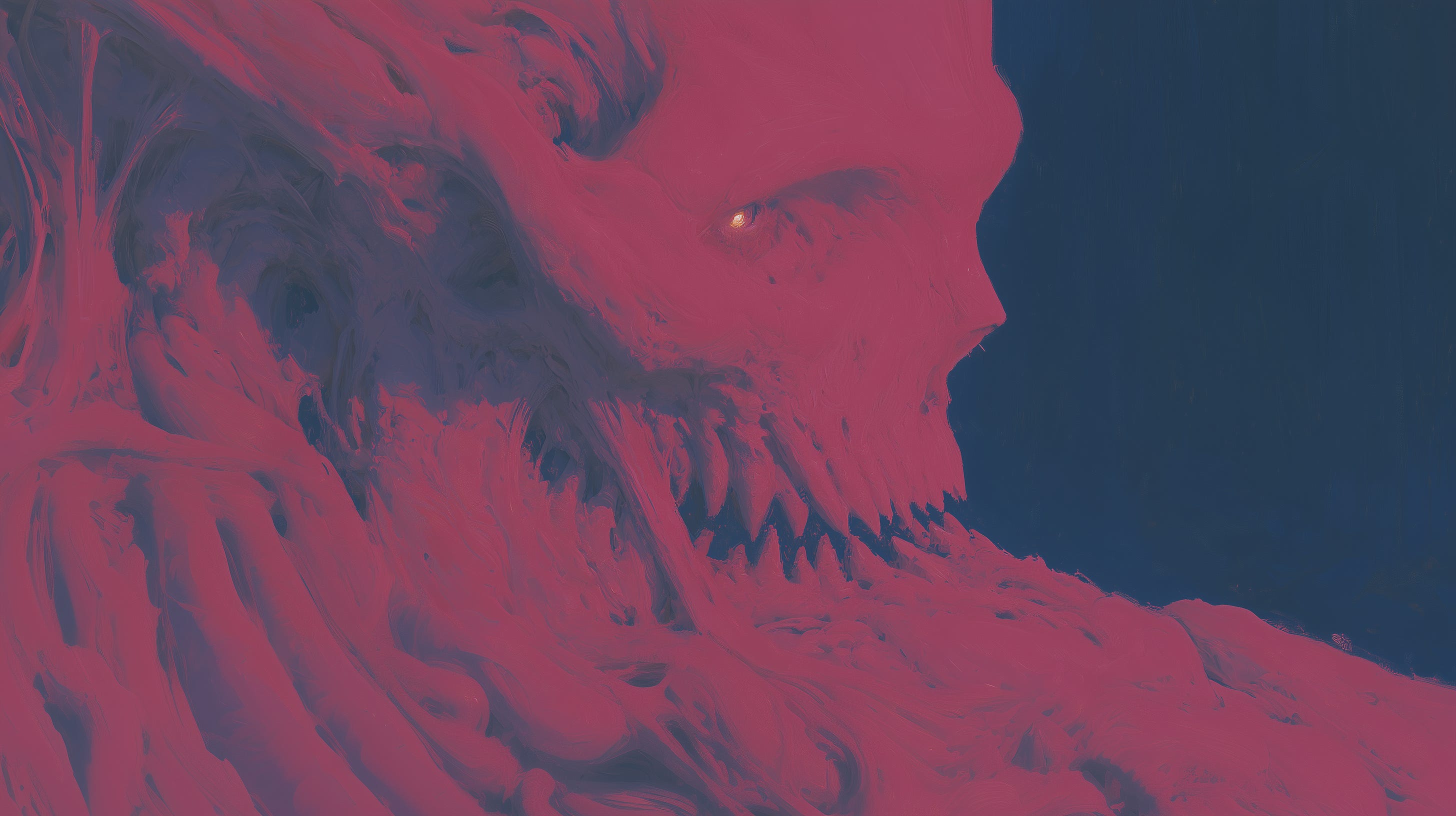
And, speak of the devil, Generation 48 was a perfect example. Their team wheeled in their atrocity on a sterile chrome gurney, plopping its drugged, swollen body into the walled-off room in front of me. They had really outdone themselves this time, creating something that looked like it had been designed by a group of giggling twelve-year-old boys. It had iridescent scales that shifted from oil-slick purple to something resembling a sunset over a chemical spill as it shifted nervously back and forth, and, as it yawned, revealed rows of needle teeth that had rims of gold leaf on them. And it was somehow even bigger than the last one, because bigger is always better.
My manager was a man named Alexander Smirnov, who walked in as I was mentally weighing whether it’d be easy to get away with ending the creature’s life immediately, eventually concluding that it’d raise too many questions.
Smirnov exclaimed, “Wow! Look at this thing! Isn’t it gorgeous?”
Smirnov resembled a knuckle, a thick one, a swollen creature with suspiciously thin limbs, as if he swallowed a prize hog and was hiding it in his belly, refusing to digest it and nourish himself. Between his ears lay a single puff of air, roaming around, excitedly colliding with the walls of his skull like a housefly trying to escape a windowpane. He had risen to his position through a kind of stochastic motion, bouncing from role to role until he’d accumulated enough momentum to become unmovable.
“Yes,” I said, “It’s certainly something.”
“Though I was looking at the statistics, this one’s bigger, sure, but it seems like the absolute size of its genome is smaller, no?”
I wanted to cradle his thick skull between my hands and push, push until they went straight through, just so I could feel and interact with the exact cluster of consciousness that produced such an inane comment.
“Yes.” I decided to say.
He nodded sagely. “Well, it’s a trade-off, isn’t it? Can’t have everything.”
“I did want to ask,” I murmured, “if you’d reconsidered my proposal yet to start a pathogen team? That I could lead?”
Smirnov looked crestfallen.
“Well,” he said, his voice dropping a register, losing the high-pitched, jovial charm it had just seconds ago. “It seems unlikely. I realize you have your own set of arguments for why we should be working on engineering viruses and bacteria, but it really is a tough argument to make upstairs. You have to understand, these people really like spectacles, things that go, pop! You know? Something they can really put alongside some visuals and copy. Our enemies must fear us, or something of the sort. Very difficult to do that sort of narrative with this proposal of yours!”
I fiddled with some parameters on my tablet, dropping in a few screaming prisoners armed with assault rifles into the creature’s den, though thankfully the glass muffled the whole debacle.
“I actually think the story there is quite clear, you know? It’s cheaper for one. Way, way cheaper. Think about the budget of the team we have running around here just to make these creatures in the first place. I wouldn’t need any of that! I’d literally just need budget to hire a dozen research assistants, a few bioreactors from a clearance sale, and the equipment needed to aerosolize the payload. It’d also be way more effective. We could depopulate a city in less than a week, all for less than a percentage of a percentage of what we’re spending now for this thing,” I said, gesturing to Generation 48.
The creature had already eaten the prisoners and, as if on cue, vomited. A spectacular, pressurized geyser of half-digested protein slurry, warped metal, and corrosive bile splattered against the glass with a meaty sound. An automated system sprayed water over the mess and the creature grunted in what seemed to be frustration.
Smirnov winced.
“Gross. Anyway, I hear you, but I feel like you still don’t quite have the rendering that I’d need. Have you chatted with Tara, our head of storytelling? She might be able to help you flesh it out.”
I had chatted with Tara. She maintained a vast, ever-growing vision-board, and she had instructed me to consider an area of the board that contained a picture of a sunset, a child laughing, and a handshake. She had asked me to ponder which of these three things my research proposal best aligned with and, after a contentious argument, I settled on the sunset. Tara waggled her eyebrows, her face stretching into a smile, and confidently announced, “Finally! This is the problem. Sunsets are what scientists want, but upper-management wants a handshake. Do you think we can get close to a handshake?”. I told her that I would work on moving it in that direction.
“I did discuss this with Tara, and she encouraged me to add a handshake flair to the proposal I wrote out.”
Smirnov nodded. “She’s very good at what she does.”
“Also,” Smirnov continued, leaning against the console, “the brass loves this. There’s a visceral quality, you know? People see one of these things and they understand the threat. You can’t put a virus on a poster.”
“Yes you can.”
“It’s not the same. It looks like a fuzzy ball. No teeth. No—” he gestured vaguely at the creature, who was lazily chewing its tail, “—presence.”
I cradled my head between my palms. “Okay. Okay. I guess the thing I’m still confused about is, why does any of that stuff matter? We’re making these things to kill people we don’t like. I do understand that, visually speaking, a big reptile is scarier. But is it actually better? I don’t think so. And in the limit case, a sufficiently lethal and contagious pathogen is very scary. Like, the Black Plague was extremely terrifying to all Europeans in the 1300s.”
“Well,” Smirnov mused, “that was a different time. People were more superstitious back then. They didn’t have the context to understand what was happening to them. These days, you tell someone there’s a new virus going around, and half of them think it’s a lie made up by their government. Maybe some of them even think it’s a good thing. But it’s hard to say that about something the size of a 10-wheeler trying to eat you!”
“It lands when they’re dead.”
“Ah!” Smirnov yelped, as if he’d finally grasped the real axiomatic difference between us. “That’s just the thing. We don’t want people to die too quickly! With a big creature, the enemy sees it coming. They have time to be afraid. They have time to tell other people to be afraid. It’s a force multiplier!”
I stared at him. He stared back, eyebrows expectantly raised, as if he had finally broken through to me.
I cleared my throat. “My point is that fear of invisible death is really a lot more significant than you’re describing it as. It swallows you up a lot more. You have to be scared of every little thing, your neighbor, your wife, the air, all of it. And you can’t even do anything about the fear, you just need to wait it out and see if your skin starts sloughing off, or your eyes start bleeding, or whatever, all the while knowing that you will have doomed those closest to you. In terms of morale loss, I’d even go so far as to say that it is even worse than dropping down a few dozen of these creatures.”
Smirnov frowned.
“That is an extraordinarily unpleasant way to think about things,” he said.
“I would contend that our job is to create unpleasant things to do unpleasant things to people.”
Smirnov made a noise that was somewhere between a sneeze and a cough. “That is one way of looking at it, but there is something to be said about having some restraint.”
“As opposed to this,” I said, pointing at the creature, “which is a measured and clinical exercise in restraint.”
“This is contained!” Smirnov exclaimed. “This is controllable. You can point it in a direction and say, ‘go there, eat those people, stop when you hit the river.’ A virus doesn’t care about rivers, and I’m certain doesn’t even know rivers exist.”
“Neither does this thing. It can swim. Generation 15 could hold its breath for six hours.”
Smirnov waved his hand. “That was a fluke. We’ve since removed the aquatic adaptations.”
“We’ve removed them three times. They keep coming back.”.
Smirnov moved to speak and could not complete the first word, instead choosing to nervously gap his mouth as he looked around, waving his hands in exasperation, as if gesturing to some invisible audience. In the meantime, I watched Generation 48 settle into a corner of its enclosure, curling up like a dog. I found myself feeling sorry for it. Then it opened one eye, a dinner-plate-sized orb of molten amber, and I remembered that I should not be looking directly at it.
“Look,” Smirnov said, “I’m on your side here. I really am. But you have to also understand the optics.”
“The optics?”
“Yes. The optics of funding a bioweapons division headed by someone who, and I’m just going to be direct with you here, comes across a little cold.”
“What?”
“You just described, in vivid detail, the experience of watching someone’s loved ones die while their skin sloughs off.”
“That was a hypothetical.”
Smirnov pinched the bridge of his nose.
“Have you considered,” he said slowly, “leading with the cost savings?”
“I led with the cost savings during the last board meeting,” I said. “You told me it made me seem ‘too focused on efficiency.’”
“Did I say that?”
“You did, and also said, and I quote, ‘You know who else was focused on efficiency? Train conductors in 1940s Germany.’”
Smirnov had the decency to look slightly embarrassed. “That may have been uncharitable.”
“It was, and, in fact, historically inaccurate. They were famously inefficient. That’s not the point anyway.”
“What is the point?”
Smirnov’s eyes twinkled with joy. He loved this. He loved this absurd back-and-forth, considered it a kind of sport. In the serpentine depths of his psychology, I was fairly certain that he had convinced himself that our arguments were a form of mentorship, and that I shared his sentiment.
I pointed at Generation 48, who was currently being battered around by a set of thick mechanical arms, meant to test its endurance to blunt trauma. “My point is: what is wrong with this one? Why can’t we just use it already?”
“Well, that one is just a prototype.”
“We’ve made forty-eight prototypes. At what point do we make something that isn’t a prototype?”
“When it’s ready.”
“When is it ready?”
“When it meets specifications.”
“Every time we get close, someone adds a new requirement. Last month it was venom glands. Before that it was echolocation. Then someone from the president’s office asked if we could make it breathe fire, and instead of saying no, you commissioned a forty-page feasibility study.”
“And it was fascinating! Did you know there’s a beetle that—”
“I don’t care about the beetle.”
Smirnov looked hurt. “The beetle was very relevant.”
“Let me ask you something,” I said, my voice almost quivering with rage. “Hypothetically.”
“Sure, shoot.”
“If I could guarantee, a genuine, bonafide guarantee, that a pathogen program would produce a deployable weapon within eighteen months, would that change anything?”
Smirnov sucked air through his teeth.
“Define ‘guarantee.’”
“Guarantee. Certainty. One hundred percent confidence.”
“Nothing’s ever one hundred percent.”
“These things are currently at zero percent. We’re currently operating at zero percent. Listen to me, listen to me very carefully. I’m offering you a hundred versus zero.”
Smirnov pressed both palms against his temples.
“That’s not how I’d frame our progress.”
“How would you frame it?”
He considered this for a moment.
“I’d say we’re at one hundred percent of our current trajectory.”
“That doesn’t mean anything,” I said.
“It means we’re on track.”
I laughed. “On track for what?”
“On track for the future,” he announced. “The future is always on track, because it hasn’t happened yet.”
A tense pause hung in the air between us. It was at this precise moment that Generation 48 took an interest in my conversation with Smirnov, and began to stare directly at us. We tried our best to look away, but its gaze was eventually impossible to ignore once it unfurled huge, elephantine ears from its nape. Its meter-long tongue slurped the recently washed glass. What I felt from it was not anger, or even hunger, but something stranger: a spirit of inquiry.
“嘻嘻!” the leviathan cooed, “汝二人何所語耶?”
Smirnov blinked. I blinked. The creature blinked, though it took nearly two full seconds for its eyelids to complete their journey across its massive amber orbs.
“噫? 汝等聞吾乎?”
Smirnov was first to break the silence. “Is that Japanese? I am sensing something Asian here.”
“It’s Classical Chinese. It said ‘can you hear me?’”
“I didn’t know you knew that language. Why is it speaking that?”
I pulled up the specification document on my tablet, trying to find any mention of linguistic capabilities across the twelve hundred pages of requirements, amendments, and sub-amendments that governed Generation 48’s design. None popped up.
“汝等胡為爭辯不休耶?” the creature asked, pressing its snout closer to the glass. Why do you keep arguing?
I felt strange. A fuzziness had erupted in my pelvis, and it was crawling up and through me, from the tips of my toes to the top of my head.
“汝貌可畏哉!” the creature bubbled, its voice a low, resonant thrum that seemed to bypass my ears entirely and settle somewhere in my molars. You look scary. I look scary? To it? What?
“This is remarkable,” Smirnov breathed, staring at Generation 48, his body in the shadow of the creature. “Do you think we could get it to learn English? The president would lose his mind. Can you imagine? A press conference with this thing? We could put it on a big, long leash, have it answer questions—”
“Smirnov.”
“—maybe get it a little hat, something military, with a—”
“Smirnov.”
He turned to me, his eyes bright. “What?”
Smirnov did look scary. His face seemed stretched out, distorted, the corners of his lips seemingly stapled to his earlobes, too few teeth, or perhaps too many, and his eyes looked like those of a goat. His skin was pooled up, whorled, divots popping in and out through the pallid canvas of flesh.
“吾聞汝議,” Generation 48 softly said, “善哉,言之有理” the glass gently cracking against its massive body curling against it. I heard your proposal. It made a lot of sense.
The fuzziness had graduated from a sensation to an architecture, building something intricate and terrible behind my eyes. My fingers felt distant, like they belonged to someone standing very far away. Smirnov looked like a stain, a globbed stain smeared across the observation room, and he began his gibbering again about something or other. My tongue was a foreign object, thick and furred, and when I tried to speak, I heard only Classical Chinese tumble out, perfectly coherent. Thick letters of the language filled every sensory experience, all sounds being replaced with onomatopoeias, everything perfectly translated before it reached my ears. I lazily swiveled my head around, which felt like it weighed a thousand pounds, and saw the immense creature staring down at me, its frame having crawled through the glass, the whole structure caved inward, without me having noticed anything at all.
Reality, for a brief moment, began to snap and click, its joints moving into a new configuration. The creature began to speak again, but its voice came from the wrong direction even though I could see its mouth moving in front of me. "कच्चित् कुशलम्?” it asked, its eyes glowing with concern. Are you okay? It had switched to Sanskrit.
I wanted to say no. What came out was a slurred: “मन्ये वायौ कश्चिद् दोषोऽस्ति”, the words filling up my vision. I think there’s something wrong with the air.
It giggled, a deep sound hammering into my ears. I felt tired. So I lay down as Generation 48 gently rose upward, through the roof, and into the endless night sky, older and older languages enveloping it the whole way. As it reached the skies, almost perfectly overlapping with the moon, it began to sing a melody that I instantly recognized as a chorus from a play performed eons ago, long before civilization as we understood it had ever existed, back before anything had names. The ballad was beautiful. I wept, and it repeated it, and I wept again. The melody carried on the wind. It drifted across borders, through ventilation systems, into lungs and bloodstreams. It filled all human minds, until every throat on earth had been taught the words, and every mouth opened to sing them, and did not close again.
I love your fiction. Beautiful, eerie, and slyly funny as always!
I love this! Did you write other fiction pieces like this before ?