
How to build a cancer vaccine, and whether they will work this time
8.4k words, 38 minutes reading time

Grateful to Benjamin Vincent and Alex Rubinsteyn for our many conversations on this topic, and comments on drafts of this essay!
Introduction
When most people hear of “cancer vaccine,” they’ll think of normal vaccines. Perhaps they’ll even think of what ostensibly is a cancer vaccine: the HPV vaccine. These vaccines—and those akin to them—are not the subject of this essay, as those are preventive vaccines against an infectious cause of cancer. When you inject one of those, you are vaccinating against a virus. The virus causes cancer. Prevent the virus, prevent the cancer. This is standard vaccinology applied to an oncogenic pathogen, and amongst the approved ones, they work decently well, but are not, in any meaningful sense, what oncologists mean when they talk about cancer vaccines.
Typical cancer vaccines are vaccines given to you when you have cancer.
These have been worked on for forty years, and have largely failed.
It’s a grim field. I’ve talked with a fairly high number of biology folks at this point, and ‘cancer vaccines don’t work, right?’ is a common sentiment amongst them, even those who have never touched the area. Of course, the researchers who actually work in this specific domain will include some nuance as to why things aren’t so cut and dry, but the point is clear: this stuff is challenging. It’s not like people aren’t trying either. There have been many, many attempts to make cancer vaccines work, and each result has left an increasingly bitter taste in their mouths.
But there is something in the air these days. If you really try, you can feel it too. There is optimism afoot in cancer vaccines. Really, there may be optimism afoot in cancer at large. Sid’s stories and Rosie’s story have lit something of a fire underneath many people’s feet, and all sorts of eyes are being directed here. Is it time? Have we arrived? Are genuine cancer vaccines on the horizon?
Maybe. But let’s not get ahead of ourselves, and ensure that we understand the science here.
The immunological theory behind cancer vaccines
It’s a bit simple isn’t it? Cancer cells futz around with their genome, which makes them produce non-standard proteins. And as you may know, the immune system has machinery for noticing weird proteins inside cells. This is true for the weird proteins produced by virus-infected cells, and it is true for cells on the verge of going cancerous. And when our patrolling T-cells detect these weird proteins, they will politely ask the cell to kill itself. This is happening inside you right now, removing many would-be-cancers before they ever have a chance to flourish.
But sometimes the T-cells fail to notice, the would-be-cancer becomes a real cancer, and it becomes an annoyance to us.
In principle, the fix is simple: give the immune system a hint. Take the cancer-flavored protein, package it up alongside a chemical that signals “this is a real threat,” and inject it. Dendritic cells pick up this signal, scurry it off into the lymphatic system, present it to T-cells, who get very upset and go off hunting for the source. And the source is the cancer.
This is all correct, but we are skipping a very difficult challenge here. Specifically that, while getting the immune system to take your hint seriously is easily done by the chemical—also known as an ‘adjuvant’—it is a bit more puzzling to figure out what the right hint is.
Let’s take a guess. How about proteins that cancer over-expresses, or expresses in tissues where it shouldn’t? This is not so bad of an idea, and there are some good candidates here. HER2, which is amplified in some breast cancers. MAGE-A3, which is normally only expressed in testis but turns on in melanoma and various other tumors. These are often called tumor-associated antigens, or TAAs, and identifying them, in the eighties and nineties, was a small cottage industry. And identify them we did; there’s the aforementioned ones, alongside MUC1, NY-ESO-1, PRAME, MART-1, and a small zoo of similar candidates. And because TAAs are shared across many patients with the same cancer type, you can build a single off-the-shelf vaccine and ship it to everyone.
Given that we still have cancer today, the TAA-vaccine era did not exactly wildly succeed. We will talk later about why, but for the moment it is enough to note that the broad strategy of “find a protein the cancer makes a lot of and vaccinate against it” did not generally produce durable clinical benefit, and the field eventually started looking elsewhere.
Where else is good to look? Well, we should ponder what T-cells actually see. When T-cells are knocking on the door of abnormal cells to judge their internals, they do not perceive aberrant proteins floating around in the cytoplasm. What they see are short peptide fragments displayed on the cell surface, loaded onto a class of molecules called MHC, meant to act as a quick summary for what is going on inside the cell. Every cell in your body is constantly chopping up a sample of its proteins and displaying the resulting fragments on its MHC. And if a peptide is not on MHC, a T-cell cannot see it. If it is, and the underlying protein from which it is derived is mutated, the presented peptide too will look very different.
In other words: perhaps you don’t actually want any old cancer-flavored protein to be part of the vaccine. You want peptides, ones that are unique to cancer, that are displayed on MHC. To be clear: of these three desires, two were already well-understood back in the TAA days. All TAA cancer vaccines of olde also used peptides that are presented on the MHC. But TAAs were only associated with cancer. They were not unique to cancer. Because of this, there exist extremely few T-cells in your body that will respond to a vaccine containing them, making any eventual immune response extremely weak. Why don’t you have such T-cells? Because of a process called central tolerance, which is your body’s attempt to prune away all ‘self-reactive’ T-cells to prevent them from attacking your own body.
But there is a different category of cancer-flavored peptide, one that your immune system has never seen before. Remember: cancer cells futz around with their genome. They accumulate point mutations, and some of those mutations land in protein-coding regions, and some of those produce slightly altered peptides that get chopped up and loaded onto MHC alongside everything else. And perhaps a tumor cell’s TAAs have mutated so heavily, so thoroughly, that they hardly resemble the natural one.
Happily for us, this is often true. These heavily altered, MHC-displayed peptides that result from genome-futzing are often referred to as neoantigens.
Neoantigens are the natural way to build a cancer vaccine. They are displayed on MHC. And the T-cell repertoire that can recognize them is, in principle, fully intact, because they did not exist when the immune system was learning what to ignore. Of course, the logistics get worse now. Useful neoantigens are unique to your tumor and your tumor alone, which means we’ll need to pump out a brand new vaccine for each cancer patient that walks through the door.
Still, maybe we’re willing to put up with this if it is a bona-fide cure for cancer. As of today, there are two ways to discover these hyper-unique neoantigens to put in a cancer vaccine.
The first is to directly pull whatever is currently sitting on the MHC of a fresh tumor cell. This is a technique called ‘immunopeptidomics’, where you grab MHC complexes off a cell surface and run them through mass spectrometry to identify all extant peptides on the surface. This is the ground truth. It is also rarely done. To do it, you need a sizable, cryopreserved tumor sample to run through the mass-spec machine, and even then you tend to recover only a sliver of the actual immunopeptidome due to sample noise. It is not something you will ever use on a routine clinical timeline, even for the ultra-wealthy slice of cancer care—the size of the tumor required is often too ‘demanding’, and cryopreservation is a type of tumor storage method you just rarely see.
The second, far more common path is to sequence the tumor and predict what would be presented on the MHC. In other words, take the sequence you’ve pulled off the tumor, compare to the patients normal sequence, and identify the mutations. For each mutation that lands in a protein-coding region, you can construct the mutated protein sequence. Simply take the reference protein, swap in the mutated residue at the right position, and you have a hypothetical mutant protein the cancer is producing. Then you slide a window across that sequence around the mutated residue and generate every possible short peptide of the lengths that the MHC tends to display—typically 8 to 11 amino acids.
So if the mutation is at position 200 of the protein, you generate every 9-mer that contains position 200: positions 192–200, 193–201, 194–202, and so on through 200–208. Same for 8-mers, 10-mers, 11-mers. For a single point mutation you end up with maybe 30 to 40 candidate peptides. For a tumor with a few hundred mutations, you end up with thousands of candidate peptides.
This should give us a list of mutant peptides that, in principle, the cell could display. What’s next? Well, there are about four steps in between a protein being expressed and peptide fragments of it ending up on the MHC. But all of these are a bit hard to directly study. One way around this pickle is to rely on an easier-to-study proxy: is a candidate peptide physically able to bind to the MHC? Now, just because a peptide can bind to MHC doesn’t mean it will be presented on the MHC, but it is a useful filter to have. Necessary, but not sufficient!
Bu it is worth asking a question: why bother with the candidate list at all? Can’t we just be maximalist about it and stuff thousands of candidates into the vaccine? It only takes one (or maybe a few) to hit. It’s not like there are any downsides to being aggressive here.
Sadly, there is a downside to being aggressive.
Namely, a concept called “immunodominance”, which is the observation that when you present the immune system with a mixture of antigens, the resulting T-cell response tends to concentrate on one or a small handful of “winners,” with the remaining antigens getting ignored or generating responses so weak they might as well not be there. Why any given peptide wins the immunodominance tournament is a complicated function of neoantigen abundance, precursor T-cell frequency, the kinetics of antigen processing in the dendritic cell, and a pile of other factors that we mostly cannot (as of today) predict from neoantigen sequence alone. What you can predict is that something will win, and there is no guarantee that the winner is one of the peptides actually presented on the tumor cells you are trying to kill.
Let’s go back to filtering the peptide candidate list. We must deal with one more thing. Not only do neoantigens differ between people, but the underlying display port—the MHC—also varies. There exist thousands of different MHC types across the human population, each one of them having specific chemical preferences for which peptides will sit stably inside it. There’s HLA-A*02:01—the most common MHC allele in people of European descent—which has a strong preference for peptides with leucine or methionine at position 2 and leucine or valine at the C-terminus. HLA-B*07:02 prefers proline at position 2. HLA-A*24:02 prefers tyrosine or phenylalanine at position 2 and phenylalanine, leucine, or isoleucine at the C-terminus.
Complicated!
This may feel like a very machine-learning shaped problem and, it has, in fact, been treated as one for the better part of twenty-five years. The earliest attempts were exactly what you’d guess from the rules above: take the observed MHC preferences—leucine here, valine at the C-terminus there—and freeze them into a position-specific scoring matrix, a lookup table that grades each candidate peptide on how faithfully it honors any given allele’s known tastes. SYFPEITHI and BIMAS, in the late nineties, were essentially this and were surprisingly decent. Then came pan-allele models like NetMHCpan and MHCflurry that learn from the amino acid sequence of the MHC molecule itself, and can therefore hazard a guess for peptide that’d sit within MHC types they have seen only a handful of times, or never at all. At first, these models were trained only on in-vitro binding affinity data between peptides and MHC complexes, but these days, they are increasingly being trained on the—albeit meager—sets of immunopeptidomics datasets out there.
Unfortunately, all existing models have a fundamental problem, and the problem will not go away even if the models are pushed to their theoretical limit: they can only approximate the population-wide expectation of presented peptides given the peptide + MHC allele input. This is not the same as what is actually being presented on the tumor cell, which comes down to whether the tumor is transcribing the source gene at all, whether its antigen-processing machinery is even intact, or maybe something else entirely. None of this is legible from a peptide sequence and an allele name! You can, of course, feed the model this extra, contextual information, but such a model does not yet exist today.
Moreover, we’re ignoring a very big dragon here: most of our understanding of MHC-peptide complexes is derived from the canonical human proteome. But there’s a lot of differences between the canonical set and the actual set! The latter of which contains ribosome-only proteins, post-translational modifications of peptides, spliced-together proteins, and likely many, many more. None of these are derivable from knowledge of a tumor’s sequence alone, and so even our starting candidate list is often a sliver of what is truly found on the surface. For what it is worth, this is likely to be true for even immunopeptidomic workflows, as interpreting those results requires comparisons to some reference set, and the typical reference set is, again, the canonical human proteome.
But let’s say we solve all these issues. Now we’ll run into a problem that no workflow, no matter how sophisticated, can fully solve while being isolated from real, living human cells: peptide presentation is not the same thing as peptide immunogenicity. What is immunogenicity? It is a blanket term that covers three characteristics: capacity for a T-cell to recognize a peptide (binding), capacity for a peptide to force that T-cell to proliferate and kill (function), and whether the net impact of this leads to any clinical benefit.
You can only test the last category via in-vivo dosing. But can you test recognition and T-cell function-altering through simpler means? Technically no, all of this stuff should come down to the individual—their TCR repertoire, their tolerance history—and not the peptide alone. But we shouldn’t be too hasty. Surely there is some vague sense of immunogenicity that could be divined entirely from a peptide sequence, and no information about a specific individual’s immune cell population, no?
People have certainly tried. In 2020, an international consortium called TESLA, the Tumor Neoantigen Selection Alliance, ran an experiment on this exact question. They handed the same tumor sequencing data—exomes and RNA-seq—to twenty-five teams, let each predict which neoantigens would be immunogenic using whatever pipeline they favored, and synthesized the predictions to test them against real patient T-cells to assess both binding and function.
The best approaches could indeed enrich for immunogenic peptides from sequence alone! Not perfectly, but better than random. To do this, they used MHC presentation, which we have already discussed to death, but more interestingly, they also used a pair of crude proxies for immunogenicity that require no knowledge of the patient's immune system at all. One is foreignness, which is to say, how closely the peptide resembles known, common pathogen epitopes. Very neat! This is an implicit bet that you carry pathogen-reactive T-cells from some prior infection years back, and an immunogenic peptide will take advantage of them. The other is agretopicity, which is the ratio of how well the mutant peptide binds the MHC versus its wild-type parent according to a machine-learned model. This is based the theory that a mutation which sharply improves binding presents the immune system with something strange, and our immune system does not like strange things. Both are computable from a peptide sequence, MHC sequence, and a binding predictor, and have continued to be used throughout more modern immunogenicity prediction systems.
These are useful, but they are, once again, statements on population-wide expectations, and not on your individual tumor.
Things may be on the precipice of changing though. The frontier models of the last year—such as TCRBagger—have begun taking the patient's own measured TCR repertoire as a direct input, conditioning immunogenicity predictions on what an actual, real patient has. And it seems to lead to improved performance! Why hasn’t everyone been doing this all along? Well, the capability to measure immune repertoires at all is relatively recent, less than a decade old, and doing it perfectly is somewhat intractable for reasons that we’re not going to get into here. And still, it does not make for a perfect neoantigen selection system.
Where do things go from here? The preclinical paths forward seem quite predictable. Creating better neoantigen candidate lists by mining non-exome regions, setting up larger immunopeptidomics datasets to train better peptide-MHC-binding models, and improving our ability to do large-scale TCR sequencing all seem important for the future of cancer vaccines.
But before moving one, I should admit something. A lot of complexity about this system has been stripped away from my explanations, since trying to be very precise about immunology is always a bit of a losing game for both the reader and writer. For those who are interested, I’ve added some further details in the footnotes.1
Now, how have cancer vaccines built on top of all of this theory fared?
The past and present of TAA/CTA cancer vaccines
In the late 90’s, GSK had identified MAGE-A3—now one of the canonical TAAs—as an interesting target for a cancer vaccine, and there was a clever reason why. While MAGE-A3 was up-regulated in both melanomas and lung cancers, it is typically only found in the testis. This is what is known as a cancer-testis antigen, or CTA. These are a very, very special subtype of TAA. Since the testis is an immune-privileged site, a human’s T-cell repertoire can be assumed not to have been pruned against MAGE-A3 the way it had been against the rest of the human proteome.
This was quite exciting for GSK, and they ended up running two enormous Phase 3 trials on it. One trial for resected stage III melanoma enrolled over 1,300 patients. And another trial in early-stage non-small cell lung cancer enrolled 2,272 patients—still one of the largest cancer vaccine trials ever conducted.
Both trials read out negative, no patient subgroup seemed to benefit, and the whole thing was shelved.
We could mention the other TAA cancer vaccines, but those feel less instructive than MAGE-A3, because MAGE-A3 ought to have worked. Every other TAA vaccine suffers from the fact that their targets are self-antigens, so the T-cell repertoire has been thinned against them. So why did this, and seemingly every other CTA-associated cancer vaccine, not work?
To some degree, the answers are basic. MAGE-A3 expression can be spotty/evolved-away from, and antigen-presenting machinery can simply fail in late-stage cancers. But the much bigger problem was the delivery method. A sobering fact of drug development is that some very clever ideas can simply be ahead of their time, and not yet have the rest of the ‘tech tree’ developed enough for them to be best deployed. MAGE-A3 was such a case. It was delivered as a recombinant protein paired with an adjuvant called AS15, both of which had an excellent track record in infectious disease vaccines and were at the cutting edge of vaccinology in its time.
This never could have worked, and to see why, you have to understand a structural asymmetry between infectious disease vaccinology and cancer vaccinology.
Oversimplifying things a lot: the immune system has two arms. The first arm makes antibodies to bind specifically to things that don’t belong (a virus, a toxin, a foreign protein), either neutralizing them directly or flagging them for destruction by other cells. The second arm sends out cytotoxic killer cells that go around inspecting other cells in your body and inducing them to commit suicide if they look unhealthy—the phenomenon we mentioned at the very start of the last section. Antibodies handle threats that exist in the spaces between cells. Killer cells handle threats that have gotten inside cells, where antibodies cannot reach.
And when you inject a recombinant-protein-based vaccine into a patient, the primary immune response created is the antibody response. This is perfectly fine for many infectious diseases, but for diseases where the pathogen lives inside cells—tuberculosis, malaria, HIV—the killer arm is required, and protein vaccines have struggled for decades with exactly these. Cancer too is in this second bucket. Sadly, neither bucket was deeply understood during the early 2000s, and so a protein-based MAGE-A3 vaccine was tried and—predictably to us in the present—failed.
What a shame. But we have evolved beyond our primitive ways. These days, instead of forcing the ‘correct’ immune reaction via a vaccine, one could simply infuse in genetically-engineered immune cells that correctly poke at MAGE-A3 the way we’d want—a treatment modality often called TCR-T, or T cell receptor engineered T-cell therapy. This is expensive and doesn’t scale and is not really a cancer vaccine, but at least it is a perfect representation of what an ideal immune response looks like.
This was tried. Twice in fact!
How did it go? It was extremely toxic. In one myeloma/melanoma trial in 2013, two patients died of cardiogenic shock within days of infusion. In another, also in 2013, the treatment produced fatal CNS toxicity in two other patients. Why? Cross-reactivity. It turns out that if you build something to interact with MAGE-A3, you’ll also build something that accidentally interacts with an awful lot else. And it empirically turned out that these engineered immune cells were happy to also react with entirely natural MHC-peptide complexes—one from titin, a structural protein in cardiac muscle, and one from MAGE-A12, a brain-expressed protein that shares substantial sequence homology with MAGE-A3.
Hmm. Well, you may ask, getting back to the subject of this essay, how about mRNA vaccines that use MAGE-A3 antigens? It’s funny you mention that. For immunologic reasons we won’t get into, this should have actually worked in getting the right immune response, and it should have also led to little cross-reactivity since we can depend on the adaptive immune system to be more careful than we are with cell therapy infusion.
And indeed, your suspicions are correct. Using an mRNA-encoded mixture of several CTA antigens2—including MAGE-A3—BioNTech ran a Phase 1 trial in 2014 that produced great immune profiles in roughly three-quarters of evaluable patients, and, in 2024, a Phase 2 in checkpoint-refractory melanoma read out positive. The failure of the protein-based platform and the successful first doses of its successor were separated by roughly twelve months!
The program ended up being cut, but it seems to be more because BioNTech has a slew of other, seemingly more promising mRNA, CTA/TAA-based vaccines.
Even more importantly, BioNTech is increasingly realizing that we live in the future. Next-generation sequencing has dropped the cost of tumor-normal exome sequencing into the range of a routine clinical assay, making n-of-1 neoantigen vaccines, ones that needn’t worry about off-target effects, genuinely viable. Even more importantly, cancer care as a whole has massively improved in ways that compound with cancer vaccines: namely, checkpoint inhibitors, which came onto the scene in 2011. While cancer vaccines help generate an immune response, a checkpoint inhibitor simultaneously prevents those T-cells from being switched off. So the stage—by the late 2010s—was set up for a very interesting future.
The upcoming era of neoantigen cancer vaccines
In late 2019, BioNTech, Genentech, and Memorial Sloan Kettering did something very brave. They started dosing patients in a Phase 1 trial of BNT122, an mRNA vaccine encoding up to twenty patient-specific neoantigens, delivered via lipid nanoparticle in sixteen patients with resected pancreatic ductal adenocarcinoma (PDAC). Why resected patients, also known as ‘adjuvant’ settings?3 The hope here was that a sufficiently powerful cancer vaccine would obliterate the remaining cancerous pancreatic cells that were left in the aftermath of the surgery, hopefully helping the ~80% of PDAC patients who experience recurrence.
Before I explain the trial results, there is some useful context to share. First, the neoantigens were identified using the exact same gene-level process as I explained in the ‘theory’ section, settling on twenty neoantigen candidates to include in the vaccine. Because no immunopeptidomics was used (though we can’t know this for sure), these candidates were genuinely a risky bet. Second, the whole process took between nine and twelve weeks from surgery to dosing, meaning the cancer may very well have diverged from the neoantigens used. Thirdly and finally, PDAC is just a nasty disease that has chewed through many, many otherwise promising drugs.
Altogether, BNT122 was put in a situation that would have been the most difficult to shine in. But if it did shine here, there is a good chance it might shine anywhere.
And in 2023, there were signs of shining. In this three-year follow-up, eight of the sixteen patients had mounted a measurable T-cell response to their personalized vaccine, and the other eight had not. Among the eight responders, none had recurred, and all were still alive. Among the eight non-responders, seven had, and the median survival time was 13.4 months. This was, in 2023, the cleanest single piece of evidence the field had ever produced that personalized neoantigen vaccines could do something real, in a disease that had defeated essentially every other immunotherapy thrown at it.
At AACR 2026, a few weeks ago as of this writing, the team presented the six-year follow-up. Of the eight responders, seven were still alive, recurrence-free. Of the eight non-responders, two were still alive.
This should bring some tears to our eyes. Pancreatic cancer is one of the few outright death sentences in oncology, and surgery does not typically save you from it taking what it wants from you. The cancer has an 80% chance of recurring within five years, demanding its pound of flesh. But for the lucky patients whose immune system listened to BNT122, nearly all of them managed to stave off the disease.
The natural question is whether any of this generalizes. Does the broader neoantigen vaccine paradigm work in the other places we’d want it to work?
Weirdly—judging by the rest of BioNTech’s clinical portfolio—the answer is an emphatic ‘no’.
Three other trials were run using the same cancer vaccine design process. In early-2025, it failed in first-line metastatic melanoma. In mid-2025, it stalled in adjuvant muscle-invasive bladder cancer, after a “safety event [was] observed in the safety run-in population”. Finally, in November 2025, BioNTech disclosed in its third-quarter report that the trial in adjuvant colorectal cancer had crossed the boundary for futility at its first interim analysis, though this trial continues with the customary “the data are not yet mature enough to draw reliable conclusions about efficacy”.
So: in a single calendar year, the same type of vaccine produced what may be the most extraordinary efficacy signal in the modern history of cancer vaccines, while simultaneously failing first-line melanoma, getting paused in bladder, and tripping a futility boundary in colorectal.
What’s going on here? Wasn’t pancreatic cancer supposed to be the hardest condition? Why is it failing on the other, easier cancers?
Let’s think. Here’s something: if you look carefully at misbehaving pancreatic tumor cells, you’ll discover something interesting. Specifically, they typically have extremely low tumor mutational burden (TMB)—the number of mutations in a cancer cell's DNA—compared to most other cancer subtypes. This is usually a bad thing, as it means fewer neoantigens for the immune system to pick up on, thus usually worse response to immunotherapy. But…this may be partially offset by the fact that if the haystack is small enough, it makes it that much easier to find the needles. So, perhaps immunodominance is a much bigger issue in higher-TMB cancers, where choosing the wrong neoantigens ruins the game, whereas it simply is statistically more likely to pick the right ones for low-TMB cancers.
In other words, PDAC may be uniquely suited to cancer vaccines.
It’s an interesting story, but is it true? Maybe not. Melanoma should be the obvious failure mode here, as it is known to have especially high TMBs. And yet, while BioNTech’s approach failed here, the other big success story in the neoantigen cancer vaccines field is Moderna's cancer vaccine, which succeeded in melanoma. Why didn’t BioNTech’s approach work? The difference may come down to setting; whereas Moderna tested their vaccine for cancer recurrence post-resection, BioNTech tested it in patients with metastatic melanoma, which is a fundamentally different therapeutic problem, and one likely far less suited to cancer vaccines.
So…maybe TMB doesn’t matter, but instead the setting in which the cancer vaccine is applied? Well, wait a minute. If cancer vaccines ought to work in adjuvant settings regardless of TMB, then BioNTech's failures in adjuvant CRC and adjuvant bladder are deeply confusing. The drug should have worked there!
It’s all quite complicated, and the same questions we’re grappling with here are the same ones that the cancer vaccine field in general is confused by. Nearly every trial result you’ll see here is heavily confounded, and teasing out what any given result means is incredibly difficult. Everything from the adjuvant used, whether combination therapy was used, whether pre-treatment protocols like lymphodepletion were applied, what it even means for a patient to have an ‘immune response’ to the vaccine, all of this—and more!—is rarely comparable from trial to trial, and naive interpretations of the arbitrary decisions made here can lead to entirely incorrect takeaways.
For instance, let us return to BNT122, the miracle PDAC BioNTech cancer vaccine. There are very, very strong reasons to, a priori, believe that this vaccine could never work. Why? Remember, its neoantigen identification process likely relies on sequencing, not immunopeptidomics. Earlier, I stated that this was a risky bet due to the very real possibility that none of these neoantigens are present on the MHC, or, even if they are, that they are not even immunogenic. Yet, their gamble seemed to pay off.
But did it actually?
Yes, patients who had a ‘measurable T-cell response’ lived far longer than patients who had no such response. But what does a ‘T-cell response’ even mean? It means that we could detect, in your blood, T-cells that recognize peptides we put in the vaccine, roughly 6 months after vaccination started. This is a very logical definition. But you may notice a bit of a sleight of hand here; this definition also demands the existence of an intact T-cell repertoire, which almost certainly independently predicts patient survival quite well! Alternatively, perhaps the well-established PDAC phenomenon of a natural immune response occurred, and the cancer vaccine’s neoantigens happened to closely overlap with the natural neoantigen response. Who knows?
BioNTech is not trying to deceive anyone here. It is very normal for Phase 1 trials to have no controls, and to be unconcerned with assessing efficacy or teasing out strict causality. An upcoming, randomized Phase 2 trial is planned, and we will learn more then. My point is that lots of press has been written about this trial, a fairly high fraction of it heavily implying that neoantigen cancer vaccines are genuinely on the precipice of working. Perhaps it is! But perhaps not, and there are at least some reasons to believe the dissenting opinion.
Before we move on, you may instinctively ask: why hasn’t anyone tried to simply do…immunopeptidomics to identify the correct neoantigens? Isn’t that the obvious path here? Yes, it’s annoying, yes, it requires doing mass-spec on a very hard-to-get type of tumor tissue (cryopreserved), but these companies have tens to hundreds of millions to throw away on clinical trials. Why wouldn’t they set themselves up for success?
It’s just really, really hard. We didn’t discuss it at length earlier, but to see anything at useful depth via immunopeptidomics, you need on the order of a hundred million tumor cells, or north of a hundred milligrams of wet tumor. And even if you can summon up this amount of tumor, the mass spec itself typically has incredibly low sensitivity. In one representative 2022 study, researchers ran deep immunopeptidomics across seventeen colorectal patients, recovered nearly forty-five thousand unique presented peptides, and identified exactly two mutated neoantigens. And one of them was a common driver mutation you could have guessed without switching the mass-spec instrument on!
But there is a way around this. As I alluded to earlier, you cannot run immunopeptidomics on every patient, but you can run it once, on a large pool of tumors, treat the peptides it recovers as ground-truth labels, and train a model to predict—from sequence alone—what the spectrometer would have seen. Do that well enough and you have laundered an unscalable wet-lab assay into a cheap computational one: the mass spec happens once, in the training set, and every patient afterward has a way to filter their cheap, sequencing-based candidates more easily.
One company took this seriously: a biotech from the mid-2010’s called Gritstone Bio. Their model, called EDGE, was trained on tumor peptides pulled directly off the MHC by mass spec, rather than on MHC-peptide binding-affinity tables everyone else was using, and they reported it predicting presentation far better than the standard tools. Gritstone then built GRANITE, its personalized neoantigen vaccine, on top of that model.
Unfortunately, GRANITE’s colorectal data came in underwhelming, and the company filed for bankruptcy in 2024. Why did the approach fail to work? It’s hard to say for certain. Yes, it may very well be that the whole approach doesn’t work, but there are nuances to keep in mind. Gritstone maybe chose a particularly bad indication, or GRANITE needed more training data, or something else entirely, and their investors were unconvinced enough to give them any more money.
The stranger approaches to cancer vaccines
Technically speaking, TAAs and neoantigens cover the full landscape of possible ways to design cancer vaccines. What remains are edge cases that lie in between: cell-based cancer vaccines, and shared neoantigen cancer vaccines.
Cell-based cancer vaccines are not super relevant from where we stand today, but they are an interesting story.
Consider GVAX. GVAX is a procedure in which you take whole cancer cells—sometimes the patient’s own tumor cells, harvested at biopsy and expanded in culture; sometimes allogeneic, drawn from immortalized prostate cancer cell lines—engineer those cells to secrete something called ‘GM-CSF’, irradiate them so they can no longer divide, and inject them back into the patient. Once there, the GM-CSF forces dendritic cells to pay attention to them, those dendritic cells scoop up whatever cancer-flavored antigens happen to be conveniently lying around in the irradiated debris, and the immune system starts hunting for cancers that match those antigens. And importantly, no human involved need know what those antigens are! The cancer and the immune system have their own private dance with each other, fumbling together TAAs and neoantigens all in one go.
This is so fun. It is like a bizarro, steampunk version of attenuated-virus vaccines. The company behind it, Cell Genesys, raised several hundred million dollars to develop this concept across prostate, pancreatic, and a half-dozen other indications, and the platform was tried in more than a dozen trials over the better part of twenty years. It did not work, and Cell Genesys folded in 2009. Why? Probably immunodominance. Asking the immune system to ‘figure it out’ works with viruses, where the number of proteins is small and uniformly foreign. A cancer cell’s proteome is incredibly large, and the vast majority of them are self-antigens.
It would be unfair, though, to leave the cell-based cancer vaccine era on a note of unbroken failure, because one of its close cousins did the impossible: it got approved. Sipuleucel-T—sold as Provenge—remains the only therapeutic cancer vaccine the FDA has ever waved through, and it is assembled from roughly the same parts as GVAX. You leukapherese the patient to pull out their antigen-presenting cells (APC), staple a prostate TAA (prostatic acid phosphatase) to the same GM-CSF "pay attention" signal, and infuse the now-activated cells back into the patient, three times across a month. So instead of relying on the immune system to figure things out at all, you’re giving it the exact substrate you care about: the TAA presented on the APC. A Phase 3 in 2010 for metastatic castration-resistant prostate cancer found that the vaccine extended median survival by about four months, which isn’t too bad.
It was also accompanied by the bizarre finding that it did not change the size of the tumor at all or change PSA levels, leading to this fun 2010 article titled ‘Costly New Prostate Cancer Drug Works In Mysterious Ways’. As far as I can tell, what Provenge was actually doing under the hood to prolong survival has not yet been excavated. Sure, yes, it certainly increases T-cell infiltration, but why didn’t it reduce the size of the tumor? Unclear!
But it got approved, which is all that really matters. So why isn’t Provenge a triumphant chapter in this essay? Because the therapy cost $93,000 per course, was time-consuming to manufacture, and got lapped within two years by oral pills—abiraterone, enzalutamide—that delivered comparable survival benefit from a bottle for a fraction of the price. Dendreon’s market cap topped $7.5 billion the year of approval in 2010 and the company filed for bankruptcy in 2014. Drugs are a hard business!
Moving on: let’s consider shared neoantigen vaccines, which are relevant from where we stand.
KRAS G12D is the single most common KRAS mutation in pancreatic cancer—present in roughly 40% of patients—and shows up in a sizable fraction of colorectal and lung cancers; in patients with the relevant HLA alleles, the same mutation can yield the same presented peptide. It is a true neoantigen in the immunological sense: this mutated peptide does not exist in healthy tissue, central tolerance has not pruned the responding T-cell repertoire, the response can be clean and sharp. But because the mutation recurs identically across thousands of patients, and presents the same peptide on the same MHC alleles every time, you can build one vaccine and ship it to everyone who has the right mutation and the right MHC allele, much like TAA/CTA vaccines.
As of today, the KRAS side of shared neoantigen cancer vaccines is ongoing. Elicio’s ELI-002 is the most clinically advanced example of it, and the early auguries are cautiously good: the trial keeps postponing its readout because fewer patients are relapsing than they had expected. But the company remains blinded as to whether that is the vaccine or simply good fortune; the pivotal analysis has slid from late 2025 to “mid-2026”.
The most interesting question her is: can’t you scale this up? The roster of recurrent driver mutations is finite, the roster of common HLA alleles is finite, and when you multiply them together and filter for the pairings that actually work, you’re left with a manageable library of pre-made vaccines that could cover a substantial portion of cancer patients today.
Unfortunately, there are very few driver mutations as cooperative as KRAS.
An earlier hero of our story—Gritstone Bio, the same entity who explored immunopeptidomics—is an exemplar of this phenomenon. Alongside poking at n=1 neoantigen cancer vaccines, they had a separate program focused on shared neoantigens. Their version was a twenty-antigen cassette of shared neoantigens drawn from KRAS, TP53, BRAF, and others.
Unfortunately, KRAS is somewhat of a freak: a single recurrent point mutation, in a gene the tumor expressed at high levels, that happens to throw off a novel MHC-binding peptide the immune system was never tolerized against, which is also immunogenic. Most of the other famous driver mutations are not like this. Most of them, even if they technically present on the MHC, are not useful neoantigens because the underlying protein is rarely expressed at high levels, or are not immunodominant, or are similar-enough to self that no mounted immune response will be sufficient.
And Gritstone discovered exactly this in a Phase 1 trial named ‘SLATE’. In it, they tested the shared, twenty-neoantigen approach and found that one of the sparsely-expressed neoantigens—TP53—was immunodominant, drowning out the more trustworthy KRAS response. They reformulated this to be KRAS-only, re-running it as SLATE-KRAS, and—as mentioned earlier—went bankrupt before a mature Phase 2 readout.
Will there be genuinely, off-the-shelf cancer vaccines someday made available? Time will tell!
Conclusion, and what lies ahead
Drug development often displays a frenetic nature, in which something promising is identified and then ground into dust by a series of poorly-designed follow-on trials before anyone can figure out exactly what’s going on. This is truer nowhere else than in cancer vaccines. To be fair, this is no one’s fault. A lot of this stuff was genuinely underdetermined in difficult-to-predict ways; who could have possibly known that the exact type of vaccination—protein versus mRNA-based—would lead to entirely different immune responses?
But it does seem like things are, against all odds, slowly being figured out. While BNT122’s cancer vaccine in pancreatic cancer has reasons for us to doubt it, Moderna’s results for their cancer vaccine in resected melanoma (KEYNOTE-942) dropped just a few weeks back and this seem to be probably real. It is in a Phase 2B, so there is randomization and sample sizes are decently high. Here is the survival curve:
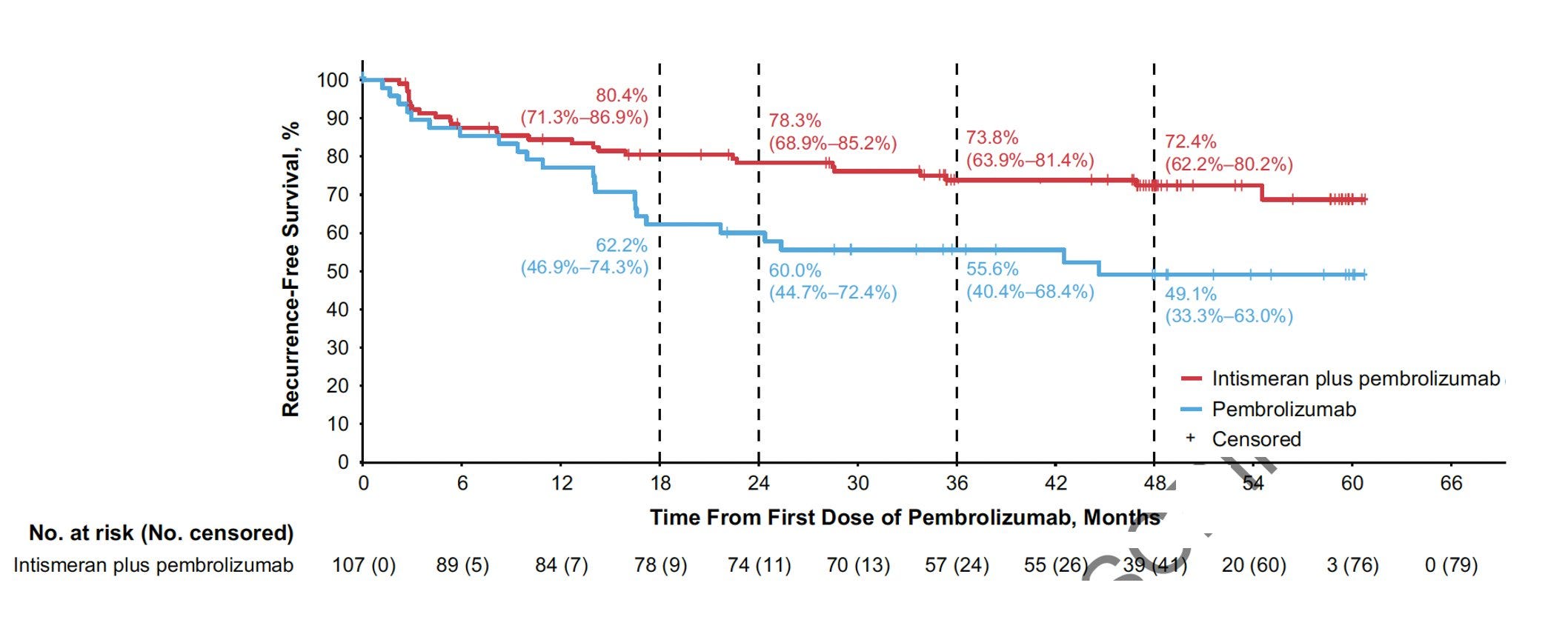
The confirmatory Phase 3, INTerpath-001, has finished enrolling roughly 1,089 patients in the same cancer setting. We should wait to cheer on too heavily, because a successful-looking Phase 2 does in no way imply a successful Phase 3! Remember that the TIGIT craze I wrote about a few weeks ago was launched on the basis of a ‘promising-looking’ Phase 2, and no Phase 3 afterwards succeeded.
Still there is a structural reason to think the present of cancer vaccines differs from the previous decades of abject failure. Recall that MAGE-A3 was not a stupid idea; it was an early one, a clever bet placed before the rest of the tech tree had grown in. Three things have since clicked into place that were unavailable to the people running those enormous, doomed protein-vaccine trials in the 2000s. Next-generation sequencing collapsed the cost of a tumor-normal exome far enough that building a bespoke vaccine per patient is feasible, mRNA delivery turned out to reliably elicit the correct arm of immunity that protein-based vaccines never could, and, perhaps most importantly, checkpoint inhibitors came onto the scene to allow cancer vaccines to actually help mount an immune response.
All three are the soil a cancer vaccine needs to grow in, and they only finished arriving in the last decade or so.
But even if it does end up working here, and Moderna finally lands themselves another blockbuster of a drug, much remains to be figured out. Remember, cancer vaccines are not a drug, not really. They are a manufacturing process, and a fairly high fraction of this process is still being worked on.
For instance: it’d be a shame if all cancer vaccines were useful for was getting rid of residual, neighboring cancer cells from surgically removed tumors—the ‘adjuvant’ setting. Yes, early-cancer detection tools are improving, so perhaps we are slowly entering a future where this does describe most patients. But from where we stand today, hundreds of thousands die each year from metastatic cancers, their organs peppered with rot, something no surgery in the world could fully remove. Immunotherapy was one of humanity’s first tools against this horror. High-dose IL-2, though brutal enough to put patients in the ICU, was producing durable complete remissions in a small slice of metastatic patients as far back as the early nineties, and the checkpoint-inhibitor revolution that followed turned metastatic melanoma—a reliable death sentence within living memory—into a disease that a real fraction of patients now outlive by a decade or more.
Immunotherapy proved this was achievable, but it is precisely the standard that cancer vaccines, for all their adjuvant-setting triumphs, have not yet come close to meeting.
Why not? Perhaps the immune priming is not yet good enough, so we must get better at selecting neoantigens. Perhaps the turnaround time for a cancer vaccine is still too long, so we must find ways to speed it up. Perhaps the immune system or tumor microenvironment of advanced cancer patients is too broken down to even listen to the vaccine, so we must reach into the realm of cell therapies, which have their own host of problems to deal with. Indeed, much work remains to shore up the full potential of cancer vaccines, and it is unlikely that a genuine, honest-to-god cure for cancer is just around the corner. This stuff is hard, and it will continue to be hard.
But despite all the tweaks to figure out, the optimism in the air should be paid attention to. For the first time, the underlying machinery is plausibly mature enough for the original, forty-year-old idea to, against all odds, finally work.
I have been saying ‘MHC’ all along, but there are actually two, very different types of MHC. The one I've been describing—class I—sits on essentially every nucleated cell, displays those short 8-to-11-mers, and is read by ‘CD8 T-cells’, the ones knocking on doors and politely requesting suicide. But there is a second, class II, which lives mostly on ‘antigen-presenting cells’, carries a much longer peptide—roughly 13 to 25 amino acids—and is read by ‘CD4 T-cells’, whose job is less to kill than it is to coordinate and egg on everyone else's killing.
I am not being too reductive by focusing on MHC-I, as all a tumor cell has is class I. But! When people go measure the T-cell responses these vaccines actually raise, a large fraction come back CD4 rather than CD8, which is a bit of a surprise to a field that had spent twenty-five years tuning its predictors for class I. So class II is unambiguously involved. Whether it is load-bearing, or merely a helpful nudge to the CD8 response, or simply along for the ride, no one can presently say. I am going to keep ignoring it regardless, because the distinction doesn't change what a cancer vaccine is fundamentally trying to do. If you desire an interesting takeaway from this, I’ll offer one up: MHC-II antigens are far worse characterized than MHC-I ones, mostly due to technical difficulities. Interesting white-space opportunity for data collection? Or a rational decision by immunologists triaging their resources? We’ll see!
Curiously, it wasn’t CTA antigens alone included in the vaccines! BioNTech also included melanocyte-specific antigens, which would lead to an immune response that could also attack normal melanocytes, causing vitiligo-like depigmentation. But this non-fatal toxicity was—in cases of fatal metastatic melanoma—viewed as a worthwhile trade. But you may ask: shouldn’t the cohort of T-cells capable of responding to melanocyte-specific antigens have been pruned out before they were allowed to roam your body? You’re right! They should have been! But some otherwise healthy patients have a fraction of these self-reactive T-cells circulating around.
No, you aren’t misreading. The word ‘adjuvant’ is indeed used in two, very separate ways. One refers to the immunostimulatory chemical given alongside an antigen/neoantigen, the other refers to treatment given after primary treatment (like surgery) to eliminate residual disease. Why is the same word used for both? 'Adjuvant' descends from the Latin adiuvāre, 'to help.' The chemical helps the antigen; the therapy helps the surgery.
I’ve always thought of a cancer vaccine as providing a "study guide" to the immune system. It points out what might be on the test, but ultimately the immune system "studies" some chapters better than others, which is exactly why the immunodominance tournament you described is such a challenge.
This approach naturally shines in earlier-stage settings where the overall tumor burden is low, clonal heterogeneity is limited, and the patient's immune system isn't yet exhausted.
But once you get to advanced metastatic disease, the sheer diversity of the mutating clones and the immunosuppressive defenses of the tumor microenvironment make the material overwhelming. At that late stage, it makes more sense to bypass the studying entirely and hand the immune system the direct answers to the test via cell therapies (TILs, TCR-T).
Of course, as you noted with the MAGE-A3 cross-reactivity trials, giving the direct answers comes with its own massive hurdles, namely manufacturing scalability, engineering necessary enhancements into the cells, related toxicities, and the lethal stakes of getting even one "answer" slightly wrong.
Great deep dive!
Marvelous writeup! I even understood several of the words.